Episode Transcript
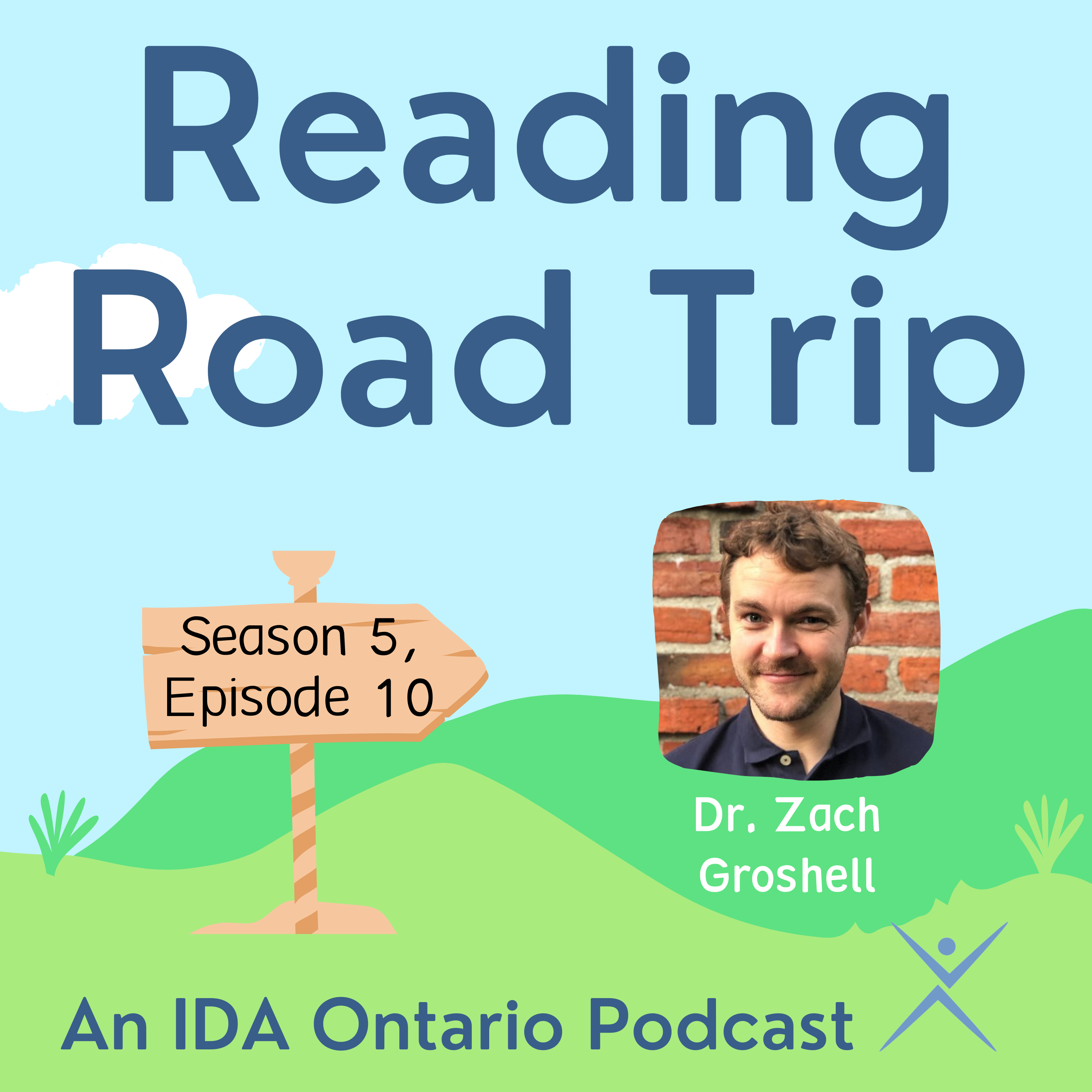
[00:00:05] Kate Winn: Hello to all you travelers out there on the road to evidence based literacy instruction. I'm Kate Winn classroom teacher and host of International Dyslexia association of Ontario's podcast Reading Road Trip. Welcome to the tenth and final episode of Season five.
Our work at IDA Ontario, which is a registered charity, depends on the generosity of people like you. If you find the podcast helpful, please consider supporting our organization.
Before we get started, we would like to acknowledge that we are recording this podcast from the traditional land of the Mississauga Anishinaabeg. We are grateful to live here and thank the generations of First Nations people for their care for and teachings about the Earth. We also recognize the contributions of Metis, Inuit and other Indigenous peoples in shaping our community and country.
Along with this acknowledgment and in the spirit of truth and reconciliation, we like to amplify the work of Indigenous artists and today we are sharing the book An Indian Residential School Story written and illustrated by Joanne Robertson with Shirley Fletcher Horn Shirley is only 5 years old when she is taken away by the Indian agent to live at a residential school. She loves learning, but she is not there by choice. From the first day walking up the long lonely stone steps of the school building, the life is hard and full of rules. Separated from her brothers and sisters, she is truly on her own. Shirley is very brave, but there is no one she loves to hold her at night when she is afraid. No one to tuck her in and comfort her. Shirley keeps going despite the sadness. She makes friends and has adventures and most of all, she looks ahead to summertime when she will be able to return to her family and the happiness of home. A true Story.
Add this title to your home or classroom library today. And now on with the show. I am so excited to introduce our guest here on the season finale of Reading Road Trip. Dr. Zach Groshell is a leading voice in explicit instruction and the science of learning. He began his career as an elementary school teacher before completing a PhD in instructional design. He is an internationally recognized keynote speaker and the founder of ER Education where he leads research aligned professional learning for schools around the world. His consultancy work includes supporting school systems on curriculum design, instructional coaching and pedagogical improvement. Zach is the author of Just Tell Them, The Power of Explanations and Explicit Teaching and publishes widely read analyses on evidence informed teaching on his website Substack and in numerous publications.
He also hosts the podcast Progressively Incorrect where he interviews leading experts in education and learning stewards science welcome to the show, Dr. Zach Groshell.
[00:02:55] Dr. Zach Groshell: Thank you Kate. Oh my Goodness. Reading Road Trip. I love this podcast. So happy to join you for the season finale. I hope you're going to keep doing seasons. You're just taking a break.
[00:03:05] Kate Winn: Yes, sure hope so. We find with the school calendar year, doing summer seasons tends to work for us. So that's what we're sticking with for now. All right. I'm really thrilled to talk about the content of your book, the idea of explicit instruction and all of that. I'm going to jump right in with the first question. So you and I share some past experience. I too was told early in my career that I should be, quote, a guide on the side, not a sage on the stage. Why was this not good advice that we received? Zach?
[00:03:37] Dr. Zach Groshell: It's not a, it's not very good advice because it doesn't really follow the trajectory of how novices turn into experts. It doesn't really follow how learning develops over time.
Being a guide on the side is, you know, first of all, there's a lot of time in the classroom. So there's, there are different phases of a lesson in which you will be circulating, you will be supporting, and you won't necessarily be talking or teaching. But the whole idea of Kate Winn the side is really try to get the, try to activate the kids and get the kids to kind of take ownership over their learning, give them things to, to work out on their own, usually problems in groups or in pairs, or get them to try to try to discover new insights out of material that, quite frankly, is very difficult material. It easily overloads them when it comes to the number of things they have to deal with in math or in science or whatever else. And also that could just be much more efficiently broken down for them, sequenced for them. Students need a lot of help during that novice early phases of learning from a teacher who structures the information just so that they get the best examples in front of them and not all the, not all of the edge cases and exceptions. And, and they, they need a teacher who can help them learn. And so the Kate Winn the side idea just really is based in this idea of discovery learning being superior to explicit instruction. And it really doesn't work. It doesn't work at all.
[00:05:18] Kate Winn: You write that gaining and sustaining student attention is a big part of our jobs, which certainly makes sense. Let's talk about a few examples of that. So starting with physical classroom setup, what are some ideas for best practice if we want to be able to best support student attention in that physical space?
[00:05:36] Dr. Zach Groshell: Right. The one of the things that teachers are going to need to do as they start the school year is really attend to their classrooms and their classroom setup. The, the environment itself often occasions certain behaviors, triggers or escalates certain behaviors. It can also just create a calming effect on students if it's set up in a way that helps them out more classrooms. First of all, have seating arrangements. And I'm a, I'm a fan of making sure students don't sit next to the very people that are going to distract them. So as you get to know your class list and you get to know certain students, you change your, your seating arrangement. So students that are helpful to one another can, can, can, can, can, can be seated right, right next to each other. But also it's important that the focus of attention be on where the information is being presented. And, and that is the front of the classroom.
So a front facing desk arrangement or. I, of course I taught elementary, so I'm on the carpet, they're sitting on the carpet. In many cases I just have dots on the carpet that, you know, that have their dot or their number so that they're seated in that place away from a, you know, another kid who might be touching them. And they're, they're facing forward. So I can scan all of their eyes and I can make sure that if you're, you're being distracted or you're not on task, I can give you a really gentle redirection or read, you know, or reminder. The classroom itself often breaks down at the level of when the students come in and enter. So really attending to that very, that beginning, strong start of a lesson when they come in from specialists or they come in from the hallway, you stop at the door and you gently and careful, you know, carefully and gradually control the entryway, regulate how kids move in so that when they come into the classroom, they sit down in a calm way to get started in their lesson.
There are many different ways as you're actually teaching to hold their attention through your attention signal through your just gentle nonverbal corrections. Many of these are in the book Teach like a Champion, like the what to do cycle, presenting very clear directions, giving lots of praise and correcting behaviors before those small behaviors get, you know, get out of hand.
Those are, those are just some. But attention is obviously the gateway to learning. It's very important.
[00:08:13] Kate Winn: What about actual classroom setup in terms of like wall decor and all those sorts of things? Do, Is there research on that or professional opinion?
[00:08:20] Dr. Zach Groshell: There, there, there is research, especially in preschool classrooms. So we, we can generalize to the extent that. That would be helpful, but there are a good number of research studies showing that students become less attentive and they. They get off task more often when they're. When the walls are very, very decorated, when they're overly stimulating, I suppose you could say they. They take examples of preschool classrooms where they sort of. They overdo it. Lots of hanging stuff is all over the. The walls and kind of coming down. And lots of colour. And if you think about students that really. You really need to be careful about those kind of details. Those kids that are easily overstimulated by just about any piece of information in the classroom. Those are the kids you might really want to be thinking about just having a. A minimalist, calming classroom decor where the things that are on the wall are. Are. Are mostly just helpful for the class, but they're not necessarily getting in the way or distracting them or pulling their eyes away from what they're supposed to be learning. I think that that's a good accommodation. It also is just helpful for time. I know a lot of teachers when they're new, they're just. They're trying their best to. To. To show up and, And, And. And they. So they come in on the weekends and I did this and they, you know, they. They put on that apron and they get to work. They get to work on making the whole classroom look like the one they dreamed of. It might not necessarily be helpful for learning. So just that very. That very minimalist approach is probably going to work for all kids.
[00:10:10] Kate Winn: All right. You also share some antecedent strategies that prevent disruptions and therefore competitions for student attention from happening in the first place. And I think you've kind of maybe touched on some of them, but anything else that you would suggest in order to kind of minimize disruptions in the first place, in order to keep student attention?
[00:10:27] Dr. Zach Groshell: Really like I'll. I'll list a couple. A couple of these. They're pretty important, really, like leaning into predictability in the environment. Right. Our classroom starts in a very similar way. We start with a, you know, a preview or a launch of the material, and then we. We go into it with a. With a modeling phase. And then we work together to make sure that we have some directed or prompted practice. And then we independently practice the material. And every day there's just a rhythm to the classroom that the kids can kind of follow. That predictability is going to help students who need that predictability. But there's also things like really increasing the amount of praise that we give students.
Students thrive on recognition. They want acknowledgement. So sort of catching students being good before their behavior starts to unravel is helpful. This looks different, you know, with older students of.
Their praise might be a little more subtle, like a wink or a nudge or just the nod of your head. But with younger students, just, just. You don't need to be too gushy about it. But just constantly saying, Akaika, he's on fire. Sally, she's on fire. Look at our class. Look at us go like, look how great we are as a class, just tackling and attacking this material together.
And then one of the main ones I talk about in the book, which I'm sure we'll get into a lot, is just increasing the number of opportunities for the children to respond. The number of times that I ask them questions, get them responding chorally, get them turning and talking. And I do that at a very brisk pace. It's gonna fill up a void that's often filled with misbehavior, with opportunities for the kids to be thinking about the material. That seems to help a lot.
[00:12:20] Kate Winn: Yeah, I like how you use the phrase on fire, because I do that with my students, too. And sometimes they'll ask me, like, I might say to one of them, like, oh, I like how you made that word there. Well, Mrs. Wynn, am I on fire? Yes. Yes, you are on fire. That's great.
Okay, so when we're talking about presenting new material and teaching as teachers do, clear explanations are so important for instruction. What are some things we should consider to help with the clarity of our explanations?
[00:12:50] Dr. Zach Groshell: Yeah, the important thing is that we. We're often told in teaching that, you know, teachers should not be the. The sage on the stage. So, like, minimize your talking and don't talk this many minutes. I've heard. I've heard a lot of different versions of that, and they're not. They're not really true in the sense that many countries in these international.
In these international analyses of teaching find that their teachers talk quite a bit. Right. They're. They're. They're some of the best and highest performing, you know, systems, the teachers talking, but they're. They're using talk to structure lots of student thinking. So it's not really about counting the amount of minutes. The truth, though, is it's very difficult for children to hold on in mind to a long winded sort of lecture, one that's meandering that kind of goes all over the place. That includes lots of anecdotes that don't relate to the material. And it's really hard for children just to deal with the content being intrinsically difficult when you add on the fact that there's just a lot of unclear sort of baggage in the exposition. So the first is to strip out anything that doesn't relate to the material, but also to be very careful that you deliver your explanations in relatively brief statements in small, itty bitty chunks that are always followed with an opportunity for children to respond. And if you look at really high quality programs like Direct Instruction, you'll see that at every opportunity, the child is required to respond. Sometimes every nine seconds. Sometimes it seems like just, just after, you know, when it comes to phonics and in math, just after every, every sound, they have a chance to respond. So there's this, there's this alternate alternating pattern that enables students to make sense of a very tight, quick and clear explanation. And then we move on and we, the teacher can use that to check.
Clarity is hard to define itself because we can only really recognize it in comparison. But I want everyone to think of like that teacher who everyone struggled to follow along with because they were always just, they were always just following all of these different, you know, sort of tangents and telling, telling irrelevant stories. Or maybe the content was just. They're always telling you about what was going to happen next and oh, we can't talk about that. And, oh, we can't talk about this just yet. And you're just like, get to the meat. Get to the point. I use those personally when I'm trying to present all the time, trying to think about the best way to convey the message. If you're on that right track and you're filming yourself, you're thinking about your exposition, I think you're going to do a pretty good job.
[00:15:51] Kate Winn: You've mentioned core responses, and I'm going to quote you here from your wonderful book. If I could implement one instructional technique across all classrooms on this great earth, it would be choral response. So I know this has been a huge change to my instruction. Why do you feel so strongly about it? And what are some practical ways we can incorporate this in our classrooms?
[00:16:12] Dr. Zach Groshell: That sounds like something that slipped past the editor because if anyone ends up writing a book, by the way, they try to take out, like your voice sometimes to make it sound readable. That definitely sounds like what I would say.
Choral response rocks it. You don't need to take anything out to do it you like a mini whiteboard or, or, or a pinch card or anything like that, you don't need to make anything, you don't need to invent a bunch of multiple choice answers to do it. You just need to use it at various intervals of lessons. And just doing that, just planning to do it and trying to do it seems to make kids listen a lot more.
You ask them, you know, like, you know, today is Tuesday. What's today? And everybody goes, oh, I'm supposed to actually listen to this person. I'm supposed to follow along and I'm supposed to know what they're saying at every, at every point in time. It's great for listening. It, it's also just great for everything we want kids to do. If you're scaffolding a complex response, there need, they need to answer lots of very short questions, yes and no questions. They need to pronounce the word that we're working on or pronounce, or they need to practice the fact or practice saying the rule of the lesson. So if you don't get them to do it, verbalize it and practice it before they get to the end, they have to do it all themselves, all at once at the very end. Choral Response is how you scaffold that, right? You say here's a rule that here, you know, here, here's a rule about arrays, right? Arrays have rows and arrays have columns. What do arrays have? Rows and columns. What's this? It's a row. What's this? This is a column. This is a row. This is a column. And we practice and scaffold each aspect of what we're doing before we ever have to go do it. It creates a bit of a community in the classroom that people, I wish they would understand the motivational side of this more because they hear dog training. They hear like this weird, like this kind of rote sort of grammar school, you know, situation going with Choral Response. But Douglamov talks about it in terms of like the great, you know, religious experiences people have where we all just sing together at church and I'm a summer camp guy and I think of all of us just singing together at summer camp and, and doing stuff together. Choral response creates this hum and this, this momentum and a lesson that I really, I wish people would talk about more. It's a great, it's a great tool. It's a fantastic tool.
[00:18:57] Kate Winn: So I know in my class, in terms of choral response, when I first learned about it, I was teaching kindergarten, as I have been for quite a while now, and we were doing patterning. And so typically what I would do is, and what comes next in the pattern? And then I'd look to see who had their hands up, and then I'd say, George. And George would say, green. I'd say, yes, green. That's correct. And then we'd move on. And then when I learned about core response, I started saying, and what comes next in the pattern? Everyone. And then I would have 32 students say, Green.
And it was just kind of mind blowing to think about the difference that that change might make. So it certainly is something people should consider. And I also started using it even with adults. There are some. I do find there are some things that they're for young children and maybe patronizing with adults, but with something like choral response. I was also doing a lot of Acadiance screener training that year within our board, and I started doing that even within the Acadiance's trainings. With a little bit of background on, here's why you might want to start using this in your own classrooms as well. And that also seemed to work. So whether you've got a young audience or an older audience, I think Choral response is. Is definitely valuable.
[00:20:06] Dr. Zach Groshell: Yeah, totally agree. And I think that switch, we got to talk about that, this podcast, that switch from an everybody, a universal response system in the classroom, certainly makes a big difference in terms of a lot of things. Attention, achievement, the culture of your classroom.
And choral response is one of five, perhaps, tools that I use that really make it so that everybody just kind of is doing everything.
It's part of a general expectation and a vibe in the classroom that we're all rowing the boat together, doing stuff together.
[00:20:38] Kate Winn: Yeah. I also use a lot of turn and talk, which I call elbow partners at the carpet, in an attempt to increase those student opportunities to respond. But you say that you see more terrible examples of this than good ones. So how can teachers tell the difference? And what can we do to make sure we're using good, valuable turn and talks in our classrooms?
[00:20:57] Dr. Zach Groshell: You can tell if a turn and talk is successful if the students are talking about the content and the prompt that the prompt that you gave them, right. There has to be a structure, structured prompt that's provided to the students. And students will often take that opportunity to not talk at all. So it's, you know, they're sitting or. And not. And not processing the material. But they, they also might be socializing, spending the time talking about something else they want to talk about. You. You can't tell a turn and talk on the basis of like a bird's eye view. You know, you swoop in as a principal and you look at the classroom and there's. It crackles to life and there's just a lot of buzz and energy in the classroom. You really have to lean in and listen to what they're saying, and you have to, you have to really pay attention. Are they, how are they reverbalizing and rehearsing what was just explicitly taught to them? Are they producing decent explanations that re. Explain what was being said to them, but in their own words?
You see a lot of just management issues with turn and talk. And I use it all the time. I use it all the time. So it's just, it just seems like it's a little more challenging or tricky to pull off. You see, with there's a group of three one day, or someone's missing their partner or the seating arrangement isn't set up very well for turn and talk in the classroom. And so students find excuses to not talk. Ah, I, I don't like his cooties or her cooties, and I don't want to sit with them. And the partners aren't arranged and that the expectation isn't taught. And students are very slow to start talking. They don't whoosh and turn to each other and start talking right away.
And the turn and talks just generally in many classrooms are just too long. They're too long. Like, the students will end up taking that as, as, as a recommendation to think longer. And they're not really thinking. They're just waiting out the teacher until the turn and talk is over. So if you do them faster, quicker, and you cut them off right when it's getting good, you start to teach the students that they've got to talk and they've got a, they've got a brain Dump as quickly as they can and then back to the teacher. I heard some things. I'm going to correct all of your turn and talks. One more. I just sampled. Now try again. Get, get. Get a better response out of your turn and talk. If you get this and if you follow that kind of rhythm, it's going to be better. It's going to be better than some of the. Some of the turn and talks that tend to fall apart by. By January, if you know what I mean.
[00:23:36] Kate Winn: Yeah, I know in kindergarten, sometimes at the beginning of the year, to make sure, like, to me, a sign of being successful is that the partner also has listened to the other person. Like, sometimes we're doing it because we oral language, like, there's a sentence starter. We want them both having a turn to say the sentence with the starter. So it's great that they got a chance to say it, but do they actually listen? So, for example, if we're doing plants and I'm saying, okay, tell your partner, what is one thing people get from plants? Well, then after we're done, I might say, okay, Gina, what did Riley say that people get from plants? And at the beginning of the year, the way they look at you, like, what? I didn't know I was supposed to be listening to what he said.
So I find that sometimes at the beginning is helpful, even just to set the expectation of. Pay attention to the other person. It's not just about what you're saying.
[00:24:22] Dr. Zach Groshell: Oh, that's awesome. Yeah. My mom used to just throw in, like, and then the cow jumped over the moon when she was talking to me. Right. And I'd be like, yeah, Mom. Yeah, that's right. That's totally correct. Right. You see that as well. The other partner needs to get something out of it. So we teach children. I think there's something bigger in all of this than just the compliance exercise of turning and talking. We teach them that they have a duty to their partner to make sure that their partner is getting the most out of the turn and talk. My partner doesn't understand.
I am accountable for making sure that they understand the material by the end of this turn and talk. And you can actually embed values and habits and promote really great learning behaviors just through a simple exercise of teaching the kids what you expect out of the turn and talk and pointing out the best turn and talks about kids end up gobbling that up. It helps them with future teachers and in life when they need to work with other people and work with partners.
[00:25:29] Kate Winn: Yeah. When it comes to teaching and Instruction, you write about the value of pairing speaking with images and drawings, which is something I've tried to get better at. I mean, I'm way better at not just like writing word for word on a slide and reading it, that sort of thing, but trying to get better not just with my young students, but even when teaching adults too. So many of our listeners are classroom teachers, so they want you practical ideas for the classroom, but some are also in district or broader roles and they are working in, you know, higher ed or benefit from working with adults, like tips for working with adults too. So how can we all get this right, whether we're teaching children, whether we're working with adults, that idea of presenting with words and also images, drawings.
[00:26:09] Dr. Zach Groshell: Yeah, I mean, as a teacher, I, I've worked with the whiteboard and I've worked with a document camera and I've worked with PowerPoint Point. And I, and I use these, I've used these variously for different subjects. But I think the important insight that comes from the world of like dual coding and multimedia principles is just that visuals are. Tend to be very helpful, except for when they're not. Right. It's, it's, it's extremely important that we make things that, like spoken words that are very transient, we make them more concrete and permanent, like readable and digestible. And to do so, you have to, you have to think about your visual presentation. It can't just be a spoken. Can't just be a spoken explanation. It often needs to be paired with precisely the stimulus the kid is going to need to encounter think about in their own workbook. Right. The kind of board meets paper, but also providing that, that, that perfect image. We know, you know, that images themselves have this, this power of helping us pair spoken words with concrete information.
So what. I mean, you can think of this too in terms of some of the mistakes we see out there.
Lots of extraneous things put on the board that are not necessary, things that are just cluttering the presentation, lots of extra texts that are put into PowerPoints, like, because the teacher's really using it as a script for herself and it's not something the students need to be seen.
And then I think that probably the most powerful insight is take all of what we know about visuals and think practically.
What should I be doing? The dynamic drawing principle that I talk about in the book is really all of them put together. I'm going to slowly populate the screen with a very careful illustration or animation or drawing that pairs with what I say. And as I go I'm going to basically fill this blank canvas up with the things that students need to know rather than launching all the images at them at once or not providing any images at all. And so this is something that goes with the content. It's the diagram fits with science in history, the timeline fits. Of course, we, we, we just need to use these as visual reference very carefully and point to them and slowly, progressively get kids to learn them. And, and it makes a difference, makes all the difference
[00:28:48] Kate Winn: when we are teaching. The use of examples and non examples is also important when you know that whole realm of explicit instruction. But even those categories just saying examples and non examples aren't quite as simple as they say seem. What do we need to know about this component?
[00:29:05] Dr. Zach Groshell: Yeah, this is the chapter. I feel like I really shortchanged. Like if I had to rewrite this book, I, I might rewrite it as just show them the power of examples and non examples. Right. I just think, I think that a lot of what ends up happening with explaining is that the teacher's describing something that the kids don't really understand until they're provided with an example. Right. And so explaining, like converting a typical explanation into like an example based exposition is really going to make a big difference.
I'll give an example. For example, when I'm teaching kids, I need to line up the columns of their, of their math problem so that the ones are with the ones and the tens are with the tens and the hundreds are with the hundreds.
I could just describe all of that, remember to line it up, remember to put the ones and so on. And I'm just, I, I'm not showing them what I'm talking about and I'm just, I'm providing this kind of almost wasted phase of, of, of what I'm doing by talking about it instead of the yada yada yada, as my friend Gene Tavernetti likes to say. Instead of all that yada yada yada, how about I just show them. So this problem is lined up correctly, this problem is not lined up correctly. This problem is lined up correctly. What about this problem? Correctly lined up or not correctly lined up, and I give them a chance to answer the example with a yes or no question. What about this problem? No, that's not correctly lined up. The ones are not with the ones and the tens aren't with the tens.
Starting with the example like on the board and then asking kids questions about relevant examples and non examples is just so much more powerful as a strategy than talking about it. Right. So, and that's hard to do because I think we're hardwired to just talk about stuff. I don't know why, what it is when we could. You could just reframe or re. Just reconfigure the exact same amount of time around presenting yes or no categorical examples and non examples for all the material we do.
[00:31:27] Kate Winn: Mm. Makes sense. We often hear about the importance of engagement when it comes to our lessons. And I'm going to read some of your own book back to you again.
This is probably my favorite paragraph in the book. I don't know, it's hard to choose, but I'm going to read this part to, to you and to everyone. I could go on and on about how engagement has come to mean entertainment, how it is used to gaslight and silence teachers, how it is used to blame them for the poor choices that children make, how it is a theory of everything among principals who don't know a lick about instruction. But let me get to the point of this chapter. At their core, teachers are not dancing monkeys, stand up comedians or circus clowns. However, we can't swing too far in the other direction so as to forget that teaching and explanation in particular is a performance.
And while performing is definitely more on the art side of teaching, there are the specific techniques from the scientific literature that teachers should find useful.
So I love the way you kind of just summarized how the idea of engagement can be, how it can go so wrong, but what elements of our performance actually do make a difference? What is helpful in the classroom?
[00:32:33] Dr. Zach Groshell: Yeah, I, I wrote that whole bit because of sort of. A lot of people have suffered under certain administrative regimes where they're looking for something and they tend to be looking for really like sort of vacuous things, empty things. And one of those is engagement. The other one, which we don't need to go into, is just this appeal for differentiation that never ends. You're never differentiating enough. There's just a few, like administrative sort of buzzwords that end up really penalizing teachers. That in this case, they, they're, they're, they're just, they're just criticizing a person's personality and the teachers getting along just fine who they are, and the children love them, but they're not necessarily the most charismatic or energetic sounding person. They calmly and deliberately teach the material. They deserve a place in teaching too. So there was a bit of frustration there as the rest, the whole book might, might come out. I tried to be honest in everything I said, but we can lean into some of the insights around Emotion. As I talk about in that chapter, one of the most emotionally resonant forms of speech is just telling the same exact explanation as a story.
Immersing children and in different worlds, talking about places and having them imagine themselves in the place or in the shoes of someone else and talking about the material just like it really, really matters, not excusing it away. Oh, this is something we have to do. But can you believe that we are all here talking about this amazing thing and, and using really rich and vivid language to paint a picture for students can, can get them just. We all know, like, instinctively there are just some teachers that made stuff interesting. What is that? It was hard for me to put my thumb on that. But they often use this emotionally resonant language and they lean forward and they make eye contact with their kids and they use their arms and their, Their. Their full body to talk to students.
And you get kids who come to school for something else, something more special than, Than they might get from watching the same thing as a movie. They're like, I'm part of. I'm part of something. And this content's interesting. This person's selling it, right? They're selling this stuff.
And because they really like it, I believe that they love it. And I think you put that in there and there's a, there's an element that goes beyond the science and just the art of getting kids to, To. To. To. To listen and love what they're learning and love what they're. What they're listening to.
[00:35:24] Kate Winn: Okay, last official question. Of course, there is a time and place in education where explicit instruction is not necessary. You're not trying to say that's all there is. And I would never say that's all there is. Can you tell us about the whole novices versus experts and how to fade guidance effectively when it is time to kind of move past that.
[00:35:45] Dr. Zach Groshell: Right. And I'll, I'll just define a novice as with another word, which is the. Which is. Which is naive, like a naive learner, meaning that they just are a beginner. They don't know anything about that topic, and there's no reason to expect them to know about that topic because we created formal institutions like school to convey knowledge that we don't normally talk about outside while we're playing or while we're, While we're at home. Schools are full of lots of enabling academic material that is rich and important and can get you very far and you can live a life of thoughts and joy that we simply don't talk about. So in most cases, when you're introducing something new, 80% or more of your classes probably never heard of it before, and they're a novice. And as they gain more and more expertise through lots of explicit instruction, it's important that the trajectory of the supports follows a very clear and elegant pattern. I'm going to start to reduce those supports. I'm still, I still call this, by the way, all of this explicit instruction. Because this explicit instruction is not just telling the children stuff, it's the whole system that gets them to be independent. It gets them to be by themselves, doing the thing all the way to the end. So when, when is it not necessary to use this instructional system?
Well, it's certainly not necessary or even available.
When you become an expert in a domain, for example, you and I working out the problems of practice, we don't often have a guide or a book that will say exactly what to do and how to problem solve. So we have to use our prior knowledge. And in many cases we want students to take what they've been explicitly taught and perhaps reorganize it in their own way, to present to someone else or to show what they know without very much guidance at all. Just a little bit of, just, just a few basic structured instructions. And in that case, we might have them do a very small application, a brief project that sort of supplements or grows them. And we would only do that when they had the prerequisite knowledge down in pat, like they know their own name. So if what. What often happens is that we ignore this novice and expert distinction and we just treat all the kids like, like they're little mini experts and we give them tasks that they can't do. And then we're surprised when we get this bifurcated class of kids who perform well in those situations and kids who are complaining or opting out or misbehaving. And it was all due to that instructional design in which we favored the children who knew the most and we disadvantaged those who came in not knowing very much about the. The topic. So explicit instructions, a full system, it goes from novice to expert. And then even after that, there may be opportunities to push them beyond what they could do with instruction, but those have to be brief and carefully designed and not take over the curriculum because there's lots to learn.
[00:39:09] Kate Winn: This has been really enlightening. I think this will be a very valuable episode for our listeners. Is there anything we haven't talked about yet you want to mention? Any last message? And also, where can listeners find you if they want to know more about your work and I think you also have another update upcoming project. If I just saw something on social media recently that maybe you can tell about too.
[00:39:21] Dr. Zach Groshell: Thank you. Yes, well, I, I, I consult with schools and I also just like to be part of the conversation, write stuff and so stuff is coming out all the time. The newest thing that has taken two years to complete with my co author, the great Marcy Stein, who is Professor Emeritus at the University of Washington, Tacoma and an expert in direct Instruction Mathematics is a new book that really will pair well with Teach your Child to read in 100 Easy Lessons, the very, very famous parenting book for teaching your child beginning reading, which is called Teach youh Child foundational math and 100 easy lessons. And we've just turned that into the publisher. It should be out in 2027. That way folks can know about the direct instruction approach to teaching math. And if they have a young child, ages 4 to 6 or maybe a remedial elementary student who doesn't have those skills, they can use this book to catch them up or to accelerate them so they're ready for kindergarten.
Other than that, check out my my, you know, all the things that Kate's mentioned, including my podcast. But let's just keep in touch. Explicit instruction rocks. It's a way of conveying information that's based on how kids learn. And I found so many people enjoying teaching better at like feeling fulfilled for the first time when they take back the responsibility that at the end of the day the buck stops with me. If the children didn't learn. It's my job to change what I do to get them there. And so the responsibility of teaching is mine. And once you change that framework and you change your method, you see kids fly. So yeah. Thanks Kate.
[00:41:16] Kate Winn: Dr. Zach Groshell, thank you so much for being here for our season finale of Reading Road Trip and we will make sure to put lots of links in the show notes so everyone can find you. Thank you so much.
[00:41:27] Dr. Zach Groshell: Thank you.
[00:41:33] Kate Winn: Show notes for this episode with all the links and information you need can be found at podcast IDA Ontario and you have been listening to season 5 episode 10 with Dr. Zach Groshell.
Now it's time for that typical end of the podcast call to action. If you enjoyed this episode of Reading Road Trip, we'd love it if you could rate and or review it in your podcast app. It's super, super quick and this is extremely helpful for a podcast. And of course we welcome any social media. Love you feel inspired to spread as well.
This podcast and all of IDA Ontario work is made possible by our dedicated volunteers, including our hard working board together with our wonderful staff and supporters like you. If you'd like to support our work, please consider making a donation. You'll find the link in the show notes.
I'm Kate Winn and along with everyone at IDA Ontario, we hope this episode and entire season of Reading Road Trip have made you our path to evidence based literacy instruction just a little bit clearer and a lot more fun.