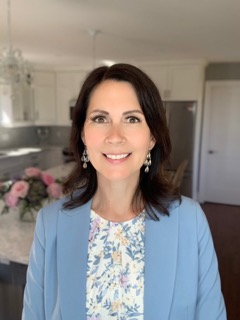
[00:00:05] Kate Winn: Hello to all you travelers out there on the road to evidence based literacy instruction. I'm Kate Winn classroom teacher and host of IDA Ontario podcast Reading Road Trip. Welcome to the very first episode of season five.
Our work at IDA Ontario, which is a registered charity, depends on the generosity of people like you.
If you find the podcast helpful, please consider supporting our organization.
Before we get started, we would like to acknowledge that we are recording this podcast from the traditional land of the Mississauga, Anishinaabe. We are grateful to live here and thank the generations of First Nations people for their care for and teachings about the Earth. We also recognize the contributions of Metis, Inuit and other Indigenous peoples in shaping our community and country.
Along with this acknowledgement and in the spirit of truth and reconciliation, we like to amplify the work of Indigenous artists and today we are sharing the picture book I Am Not a Costume by Maria DesJarlais. Illustrated by Regina Alice Willman. Five year old Ayesha's school is having a costume party and she is so excited. But when Ayesha arrives at school and sees other students wearing fake regalia, she's confused and upset. She doesn't understand why they think her culture is a costume. Ayesha turns to her family and together they come up with a way to teach her classmates about her culture and how to honor her people respectfully by holding an assembly at the school where members of Ayasha's family and nation tell stories and explain the history behind their regalia.
Add this title to your home or classroom library today.
And now on with the show.
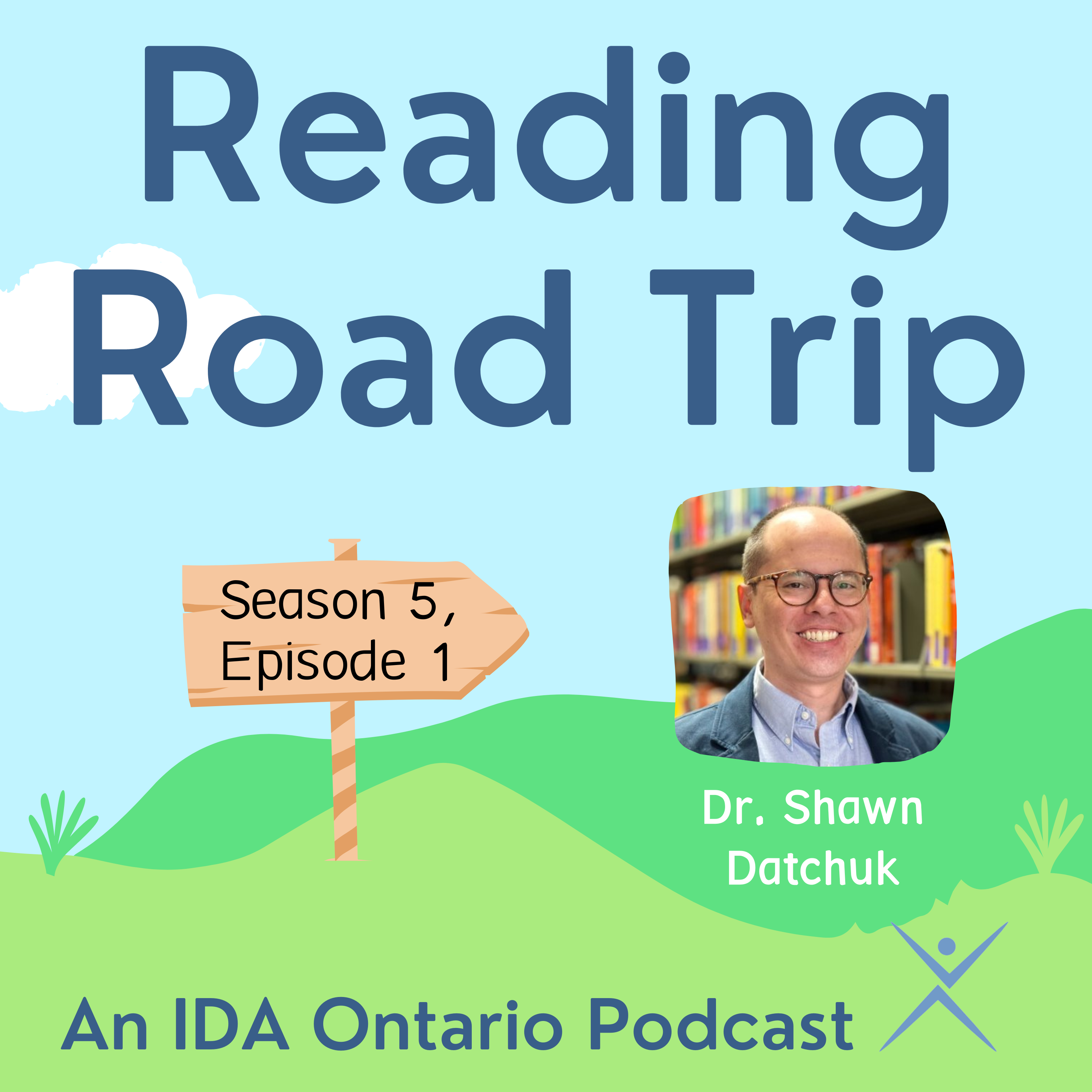
I am so thrilled to introduce my guest here this week on Reading Road Trip. Dr. Sean Datchuk is a Professor of Special Education at the University of Iowa. Previously, he was the Director of the Iowa Reading Research Center, a K12 special education teacher, elementary teacher, and academic director.
He received his PhD in special education from Pennsylvania State University. He researches evidence based methods to improve the writing and related literacy skills of K12 students with and without disabilities. He has over 30 peer reviewed publications, has delivered more than 70 conference presentations, and has helped secure and manage over $16 million in federal and state funding. He serves on the editorial boards of eight peer reviewed journals and is the Chair of the Research Committee of the Division for Learning Disabilities Association of the Council for exceptional children. Welcome Dr. Sean Datchuk.
[00:02:24] Dr. Shawn Datchuk: Okay, thanks for having me.
[00:02:26] Kate Winn: So I have heard you speak a lot about handwriting and I really thought it would be a great topic for us to dig into today. I'll mention in a little bit how it's now in our Ontario language curriculum and that sort of thing. But first, I know you've spoken about three related processes that are involved in handwriting and I'm Hoping you could quickly explain each of those for listeners.
[00:02:46] Dr. Shawn Datchuk: I would be thrilled to. So I tend to think about writing as occurring in three buckets, so to speak. There's arguably more buckets. These I think are kind of the high leverage ones. The first would be orthographic coding. Now orthographic coding refers to students committing to memory the shape of a letter. So when we think about the letter M, let's say all the twists and turns, or if you're doing an uppercase, the sharp angles, the letter M when a student hears the name M or the sound M that is attached to a visual representation inside of students memory. So orthographic coding is incredibly important for handwriting, also for reading. Second is fine and gross motor movements.
Fine motor movements generally referred to in handwriting, the short little movements we do with our fingers or students do with their fingers. Gross motor referred to the body position, a shoulder perhaps having your head at an appropriate angle. So fine and gross motor movements definitely an important part of handwriting. And the third bucket would be visual motor coordination.
I don't know about you Kate. It seems like you're, you're pretty put together. So I think you probably were a kid that drew within the lines or colored within the lines quite a bit.
[00:04:00] Kate Winn: That's fair. Yeah.
[00:04:02] Dr. Shawn Datchuk: At least for, at least for me, I drew outside of the lines quite a bit. But visual motor coordination refers to, particularly in handwriting, when a student comes up to, let's say the top line, they stop there or let's say the midline. So it's the ability to make small adjustments, smaller, large adjustments to what a student's writing based off of what they're visually seeing. So three large buckets, again, orthographic coding. One, two would be fine and gross motor movements. And then three would be visual motor coordination.
[00:04:30] Kate Winn: Perfect. Thank you. Okay. As I mentioned, we do see handwriting reflected now in our Ontario curriculum or in the US you might call that your standards. So we have our brand new kindergarten curriculum going into effect in September which states that students need to begin to print upper and lowercase letters with appropriate formation patterns. And then starting in grade one, in our language curriculum we have print upper and lowercase letters with appropriate formation patterns, size, orientation, placement, spacing. When we get to grade two, they actually add the word print legibly and fluently, which I think is really important.
So we know that we want students to be able to do these things. But, but what I want to ask you about is can you share some of the research to support explicit instruction on these skills?
[00:05:14] Dr. Shawn Datchuk: Great question.
The most recent publication would be by Ray and colleagues from Australia.
They did a systematic review specifically for kindergarten students. This was done in 2022. And what they found is pretty helpful findings. One would be that students who received explicit instruction in handwriting improved their letter formation so they were able to write more legible letters and that ultimately at the end of the day, that's what we want out of handwriting instruction. Two is that they found, and this is I think kind of the secret sauce in handwriting, they found improvements also in early literacy skills. So in addition to students benefiting from explicit instruction how to form letters, that also had the side benefit of students committing to memory and showing improvement on several early literacy measures. One would be letter names. Two would be letter sounds. So the letter name, let's say M, the sound M. And they also found an improvement in word reading skills as well. So when we think about how closely related writing is to reading, I think handwriting is a crystal clear example of that.
[00:06:27] Kate Winn: So while here in Ontario we do have a play based kindergarten program, you would think that the handwriting piece would be one of the pieces where we do want to make that time for explicit instruction. Just kind of kids learning on their own and experimenting and putting out the materials and discovery is not going to be the best way to teach this skill.
[00:06:46] Dr. Shawn Datchuk: Yeah, and I think you're bringing up a great point there. Is that what we find in handwriting, and I'm a former elementary teacher myself and you know, looking back at my performance as a teacher, knowing what I know now, I definitely would have changed some things up. And I think handwriting, we can think of it as being caught to some degree so that students will just catch it through a happenstance through play. But I think what research specifically shows is that it's best thought of as taught and not caught. So while play can certainly benefit, I have a four, I have a four year old son at home, so he plays a lot. He does a lot of coloring, a lot of drawing. We have like dry erase board, a lot of crayons, everything like that. Those skills that he's building are two of the critical skills related to handwriting. Again, so visual motor coordination, also fine and gross motor movement. It doesn't really address though the orthographic coding piece which is committing to memory the letter shape and it's attached to a letter name or letter sound. And I think that's why play based education, I think certainly has a critical role in helping early elementary pre K kindergarten students really thrive. But I think there needs to be space for explicit instruction handwriting to kind of make that next Step.
[00:08:03] Kate Winn: Great, Great point. Thank you. You did a fantastic webinar for OnLit, and people can access
[email protected] if they're interested. And in that webinar, you shared five great tips related to that explicit instruction piece when it comes to handwriting. So I'd love for you to expand a bit on those here today.
First one was you recommend that we should determine a scope and sequence of those visual letters. So what do you recommend we do for that?
[00:08:29] Dr. Shawn Datchuk: Yeah. So scope and sequence refers to the depth or how many letters you're going to teach and then how they're specifically sequenced. And what I'd like to encourage our listeners to think about are two important questions. One would be, are your students currently learning how to read letters in another curriculum? So let's say you're a kindergarten teacher. You have a set standard literacy curriculum. It's important to consider what letters are students learning there, and do they have handwriting activities or exercises already baked into it? If the answer is yes, I think it is to the teachers and the students benefit to align the scope and sequence of the letters that students are reading with those being the ones that they're also learning how to handwrite.
So precisely what I mean by that is that let's say if a student is learning M A and T, M A and T as the first three letters and they're learning how to read those to minimize confusion, what a teacher would want to do is specifically teach students how to handwrite those letters that they're learning how to read.
It not only minimizes confusion, it potentially leverages the strength between, oh, hey, I know how to read this. Oh, and now I know how to write this as well. So it strengthens that reading writing connection, that is indifference to, let's say, and I've heard this from teachers all across the United States, and I'm sure the same thing in Canada to where a teacher would be like, oh, okay, I want to do handwriting, but when I get a handwriting curriculum, let's say they might be learning three completely different letters right off the bat than what I'm what I'm teaching my students how to read. So instead of their reading, let's say handwriting starts with L, I, and let's say S.
That can cause confusion for students, particularly those initially learning these important reading and writing skills. So that's one. So are your students learning how to read in another curriculum? Align your handwriting with reading would be the answer there. And the second important question when you're trying to figure out a scope and sequence Would be, are your students learning upper and lowercase letters?
Now, Kate, you just mentioned that students are expected to learn their lower and uppercase letters by the end of kindergarten.
One of my hot takes on this would be, it's probably beneficial for students to initially focus in on learning as many lowercase letters as possible prior to diving deep into uppercase. Now, there's nothing wrong with teaching students uppercase letters. You know, I think an important part of kindergarten is students learning how to write their name. And then so obviously writing their name, they'll have to at least learn one uppercase letter to begin.
One, if not two, uppercase letters for their. For their last name. That's an important part. But when we think about the critical connection between writing and reading, over 90% of Letters students read are going to be lowercase. So uppercase letters that students encounter during reading really happen again in proper nouns, the beginning of a sentence.
But the vast majority of letters that students read will be lowercase. Why is that important?
Well, lower and uppercase letters can look drastically different from each other. So let's take a look at the uppercase d. The uppercase D, for whatever reason, goes to the right, and then the lowercase d goes to the left, which probably explains some of the BD reversals that we see in kindergarten.
Why does the d go a different direction based off our upper lowercase? Who knows?
But when we think about it from a student perspective, leveraging kind of the bang for the buck or the high leverage practice there would be trying to teach as many lowercase letters as possible. But again, you aren't harming anybody by teaching uppercase letters. That's just something that you want to be cognizant of as a teacher. If you start to see students making errors or becoming confused while you're introducing uppercase letters, it's because in some ways, it's a different type of letter that we've kind of mapped onto the same name and sound. So that would be the first kind of aspect, is thinking about a scope and sequence of visual letters.
[00:12:31] Kate Winn: I love how you are affirming exactly what we do in our classroom. So that's great.
[00:12:34] Dr. Shawn Datchuk: Thank you.
[00:12:35] Kate Winn: Your second tip was use materials with visual cues for letter formation. Can you tell us a bit more about that?
[00:12:42] Dr. Shawn Datchuk: Yeah. So visual cues is kind of a technical term for these several kind of things that appear on what's projected, let's say, on a smart board or whiteboard, and what's on the paper that students initially learn a letter. And there are three kinds of visual cues. Used in research studies. One would be dotted lines. So a dotted line of the entire, let's say Alphabet to where students trace over it to write the letter. So dotted lines two would be arrows. So there'd be these little arrows right next to each letter that show students this is the direction your letter stroke should go.
So let's say if we're talking about the letter M, there's going to be multiple arrows there. Starting at the top goes down, and then there's another curved arrow. So the arrows show students, oh, here's the direction of your letter stroke. And then the third visual cue would be numbers. Some kindergarten students initially will come ready to already know their numbers to where those cues can be beneficial. Sometimes it might take a little bit towards the middle or the end of kindergarten to really pick those up. But the number would have the suggested sequence of the letter stroke. So the visual cue would be dotted lines for tracing, arrows for direction, and numbers for sequence.
[00:13:54] Kate Winn: So what I understand then that you might disagree with an Instagram post I saw the other day where the poster was very adamant that tracing letters is not only not useful, but is harmful. It is harmful for our children if we have them tracing letters. So sometimes I see these things and my blood pressure goes up.
But are we safe to say we're not harming students if we're giving them dotted letters to.
[00:14:19] Dr. Shawn Datchuk: In fact, we're helping students. So the research based answer there would be that dotted, tracing dotted lines actually help students initially acquire the skill. And something I've come to appreciate over particularly the past couple years, Kate, is that people have very passionate feelings about handwriting. I never knew it, but wow. Some of the most strongest reactions or emails I get have to do with either print handwriting or cursive handwriting. So I think it just speaks to how durable handwriting is here to stay, even in this age of technology.
[00:14:50] Kate Winn: Well, and it's funny because the post asserted research says, but then when you kind of follow that thread back to actual research, you realize that is not at all what the research said. So thank you. So another tip of yours was plan for most to least scaffolding. Tell us about that.
[00:15:07] Dr. Shawn Datchuk: Yeah, I'm probably preaching to the choir here, Kate. If you're listening to this podcast, explicit instruction is kind of where it's at. So mostly scaffolding would be, again, another technical term for explicit instruction. Usually explicit instruction. We start with the most amount of support upfront through modeling. So teachers show and tell, and then teachers gradually fade away their model and then they engage in the prompting to where they're prompting students through guided practice, providing praise, in this case for legible letter formation, saying the letter name, the letter sound, and then finally checking for student independence. So in addition to using visual cues, visual cues can be baked in the model. They could be baked into student guided practice. And then what we see and what I think effective evidence based curriculums do is that they fade away the visual cues. So initially they might start with the dotted lines, also the arrows and the numbers. Then they could fade away the arrows and numbers. So where now students are just kind of tracing and then finally they actually get rid of, of the dotted lines. And now students need to recall that from memory.
[00:16:15] Kate Winn: Well, I have a resource that I love that actually kind of works through that on one page. And it is a worksheet. Sometimes worksheets are a bad word in the, the early literacy world. But, and what we really try to do too in our program is we have the student complete their worksheet one to one with a parent volunteer or with their grade seven eight reading buddy. And so the sheets kind of work through. It's got the numbers, arrows, dots, and then it fades away where it's just the dots and, and then it's just a dot to show where to start. And then there's a line where you just kind of try it yourself. But it's funny because our buddies are grade seven and eights and I taught the grade seven eights when they were in kindergarten, but that was before I knew all of these best practices.
So I will sometimes tell them, if you don't make this letter, you know, correctly, it's my fault. But let me reteach you now because I need you to teach your kindergarten buddy properly. But I do think that having that one to one support as opposed to like we don't, like we've got 32 kids in our class, we don't handle 32 worksheets. And then we have absolutely no idea how they're doing it because sometimes the letter might look beautiful at the end, but you don't realize that they've lifted their pencil up four times when they didn't need to. And, and that sort of thing. Right. So no, I appreciate that scaffolding tip. You also suggest keeping instructional language clear, consistent and concise.
[00:17:29] Dr. Shawn Datchuk: Yep. And then so here's one of my hotter takes for handwriting.
And then so hopefully I don't make your blood pressure rise, Kate. Kind of like an Instagram post, but that's okay. So when we think about explicit instruction again across whatever we're teaching we want students. We want the message and communication to be understandable to all students.
So that's one. So that's. This phrasing of clear, consistent, concise is used by Anita Archer, Charles Hughes and their great textbook on explicit instruction specific to handwriting. What I'd like your listeners to think about and critically is when students are learning how to write individual letters. Let's say you're also using the visual cues, so you have the dotted lines, you have the arrows, and you also have the numbers.
What do you want your students to hear you say when you're writing the letter?
Ultimately, we want students to sub vocally say that to themselves so that it gets committed to memory.
We can certainly go through many different exercises. I've heard, I've been in lots of kindergarten classrooms, pre K classrooms, first grade, to where teachers will do kind of really fun kind of songs or different things on like, okay, so when you start your C, you start up here in the midline and then you come down and then all, all those things. I think there's a place for it. It could be fun. But here's my hot take. This is that all those things we probably just want to focus in on what's the letter name and what's the letter sound. I think that that's the clear, consistent, concise language. We actually want students to sub vocally keep rehearsing. So what do I mean by that? I just sort of spewed out a lot of technical terms.
When you're modeling a new letter, I think the most important part of that model for a teacher needs to be, let's say they're writing the letter M, the name is M, say M M, the sound is M.
And then so when students are writing that we want them to sub vocally say M M, or let's say it's T, T, T, T, T because we want them to sub vocally rehearse that. So what that means is, is that as instructors, maybe we don't need to provide all that air space to vocally describing each individual stroke and where to start and where to stop.
Maybe we just rely on the visual cues because those are already there. And then so students can see that.
But what we want to focus in on for vocally would be the name and the sound.
So when we say clear, consistent, concise, I think the research is clear that what one of the important aspects that we want students to vocally rehearse themselves is actually be the name and the sound and not necessarily kind of our descriptions on where to start. Where to stop, et cetera.
[00:20:33] Kate Winn: Thank you. Yes. And I have seen some. Excuse me, a bit of a cold right now. I have seen some letters where it's like almost multiple line chants and character names and everything. Right. Like in the letter formation. Now I will say I use a sky grass ground template on the smart board. So let's say we're doing written word chains. So it's not specific letter formation instruction, but we're doing something that involves writing.
Let's say we're changing cat to cap. And then I'm looking around and seeing a lot of the letter. The lowercase P is kind of flying up high. Right. So I may say, oh, remember the tail needs to go underground or you know, something like that. But it's not the kind of thing that I'm expecting them to sub vocalize or memorize to repeat when they're doing those letters.
I do find that kind of visual helps them a little bit when we're doing that sort of activity.
[00:21:19] Dr. Shawn Datchuk: And I think there's also something to be said for like my son.
So I have a four year old and a nine year old at home and my nine year old still remembers his handwriting lessons from kindergarten because his teacher used like ice cream scoops on, whereas like how many scoops did you have? Was how, how high your letter should be interesting. And so he, you know, he still talks about that because. So I think there is something to be said for.
You want writing instruction to be fun.
And so I think those are kind of the ways that teachers can kind of adopt it and make it fun and a positive culture in their classroom.
But you know, and to your point, Kate, I think there are different ways that teachers can kind of structure or present what writing looks like. I think from an instructional language perspective, as long as teachers are focusing in on that important connection between handwriting and early reading, I think that that's kind of the message.
[00:22:16] Kate Winn: That's great. And your fifth tip about the explicit instruction was to engage students in memory retrieval of specific letters with COVID copy, compare. How does that work?
[00:22:27] Dr. Shawn Datchuk: Yeah. So when we want students to retrieve from memory that this is a letter shape, this is how let's say the letter P is formed.
We need to provide students model, guided practice, independent practice, but they also specifically zooming in on that last part of guided practice and independent practice, they need repetitions, retrieving it from, from memory to where they aren't copying it from something in the environment, so they aren't seeing the letter P in this instance and then trying to kind of form it while looking at it. We actually want that formation to be crystal clear in their memory.
So as a result of modeling, guided practice to where they're tracing. And I think this is why tracing can be such an important part of modeling and guided practice.
That they're internalizing. That's what that letter looks like.
That's what this letter P looks like.
So when we take away the dotted lines, when we take away the arrows and the numbers, we can have students engage in what's typically called. Yeah, to your point, Kate, Cover copy compare to where they initially see the letter, then they cover it from sight.
So I've seen teachers kind of create. It can be done through just going over to the dollar store and getting some manila folders and cutting three strips in the COVID to where there's one flap, two flaps, three flaps instead of one solid flap to where they have the initial flap open that has the letter student C. Then they close the flap, and then they try to copy it from memory. So they covered up, let's say, the letter P. They try to copy the letter P from memory, and then they open up the top flap again to try to compare. So they look at it, cover it up, they copy it from memory, and then they compare what they wrote to the model. And then if they need to, they make adjustments.
So that cover, copy, compare can be just kind of a way to think through how do I have students actively practice how to retrieve a letter from memory so you can do that with individual letters. And then other studies have done what's typically called, like, Alphabet warm up or Alphabet practice to where we try to have students write as many letters of the Alphabet from memory as possible. And then some programs will kind of juice that up a little bit to where they'll actually show students parts of the Alphabet. So let's say a, B, C. And then it'll be blank, blank, blank. And then they'll pick up the sequence, and then students will have to remember, okay, what's after C? What's after D? What's after E? So they're giving students that memory retrieval practice to build up that. That memory.
[00:25:10] Kate Winn: I like that manila folder idea. I might have to use that one. Thank you.
[00:25:13] Dr. Shawn Datchuk: Oh, yeah.
[00:25:14] Kate Winn: All right. So would these tips, like talking about research and talking about explicit instruction, everything we've talked about so far, do they apply to cursive writing as well? I know in Ontario, when we get to grade three, we have begin to write in cursive, forming letters with appropriate formation, pattern, size, placement, and spacing et CETERA and then that goes on through the grades to continue and then eventually write fluent cursive, etc. So would the things you're suggesting apply to that sort of instruction too?
[00:25:41] Dr. Shawn Datchuk: Generally, yes. So there is less research on cursive handwriting than print handwriting. Myself and some colleagues at the University of Iowa are just wrapping up a systematic review of any cursive instructional study that's ever been done, which is humbling to kind of take a look all the way back to some of the studies use quill quills and inquills. So those weren't that relevant. So we didn't include those. But what we do see is that across there were 26 total studies that's ever been done for cursive handwriting that matter criteria. And we see some general support for the use of visual cues. So again, dotted lines, arrows, numbers, also use of most to least scaffolding. So explicit instruction and also memory retrieval.
Now here's a. Here's. I think a unique thing about cursive is that I think it reflects two things, is that students tend to learn cursive after print, so they're slightly older, so they have some more reading skills under their belt, so to speak.
So that's one, and then, then two. Is that cursive? Since we're teaching students to join letters or connected text with tails or loops, you pretty much end up teaching spelling, whether that's an explicit part of the lesson to where you're actively teaching spelling rules, or you're implicitly teaching it because just by the fact that you have to teach students how to connect these letters, they're spelling whole words. We do see slight increases in students spelling performance as a result of cursive handwriting instruction as well.
So there's less research again on cursive than print. But what we do see is at least hopeful and promising.
[00:27:21] Kate Winn: Interesting. How much time do you think we should spend on explicit instruction on this skill in our classrooms? Like minutes per day or days per week, that sort of thing?
[00:27:30] Dr. Shawn Datchuk: Yeah. Good news is that it can be done with a minimum investment of 2 to 3 days, 15 minutes each session. So I'm primarily basing that on Steve Graham and colleagues.
What's a writing podcast episode without mentioning Steve Graham at least once?
Steve Graham, he did several studies along with Karen Harris that looked at explicit handwriting instruction and they found measurable gains two to three times per week, 15 minutes each session.
[00:28:01] Kate Winn: Okay, how important is grip when we are teaching students their letter formation and when should we start kind of correcting bad habits with that? So in Ontario. Our kindergarten program is kind of like a Pre K kk right. Our year ones and year twos together. So as soon as they come in and we're teaching them to, you know, hold that writing tool, we're trying to teach it, you know, the, the helpful way. We don't want them holding with their like a fist and that sort of thing. But how important is grip? How much does it matter? When should we start trying to get it right?
[00:28:30] Dr. Shawn Datchuk: Yeah. So I think whenever a teacher is modeling a new letter, it is a great idea to model appropriate pencil grip. Now, pencil grip. This is where I think some people can have some strong feelings. The pencil grip, the classic tripod hold. When you hold your pencil or pen and a tripod.
If you take a look at research, there isn't a whole lot of difference in student writing performance. It's very negligible between a perfect tripod or just slight variations. All these tend to be okay.
Now what does that mean for an instructor? I think what that still means though is that you do want to model an approach appropriate pencil grip. I wouldn't be tremendously concerned if you just have a perfect tripod or kind of slightly off tripod. I think all those are fine. The research is clear to your point, Kate, that the one pencil grip that actually hinders student legibility and also leads to a quick handwriting fatigue is that fist grip to where students are just holding the pencil in their fist. It kind of makes my teeth hurt. I'm just doing it right now.
But that's common, particularly for early A pre K kiddos like my 4 year old. That's his, his dominant grip right now. And then now he's trying to. We keep modeling, oh, this is how you kind of hold it.
But so again for teachers, what does that mean? Model holding model. When you're modeling initial letter introduction, let's say you're teaching students how to write the letter S or the letter R.
Model how to hold the pencil, provide and praise students who are holding their pencil using that kind of tripod. You can certainly provide reminders for students. But at the end of the day, I wouldn't spend a tremendous amount of instructional time kind of correcting and repeatedly correcting holding pencil. I think it should be enough for most students to. For the model the prompting and then simply relying on there's going to be slight variations and how students hold their pencils. As long as they're not holding it with a fist.
Research suggests that it should be okay.
[00:30:34] Kate Winn: Okay, great. Yeah. I find some come in holding it With a fist. And the other thing a lot of kids do when they're starting is hold it way too high. And so that's the other thing where I'll say, you're not going to be able to make it do what you want unless you hold it down. Down, lower. But, yeah, it's good to know that there's variations on the tripod grip. We don't need to get too finicky about that.
[00:30:50] Dr. Shawn Datchuk: Yeah.
[00:30:51] Kate Winn: Okay, so assessment I want to talk about next. So I have been immersed in the world of reading assessment a lot for the past few years, but thinking about this sort of handwriting assessment, what would you suggest for that?
[00:31:03] Dr. Shawn Datchuk: Yeah, congrats on that book, by the way.
[00:31:04] Kate Winn: Thank you.
[00:31:05] Dr. Shawn Datchuk: Yeah. For handwriting, there's two real simple, easy ways that they could do it. One would be called a copy task. Another would be an Alphabet task. Alphabet task has the most bang for the buck. So I'll focus in on that more. Alphabet task is basically you have students have a piece of paper. It could be any paper of the teacher's choosing. Pencil teacher has a timer, and the teacher instructs the students. Okay, everybody, I want you to write the Alphabet as many times as you can. I'm only going to give you a minute, so try your best.
Here we go. And then the teacher might have to model this the first time, but the idea here is that you're just giving students a short burst of time to try to write as many letters of the Alphabet as possible. And at the end of the 60 seconds, you stop the timer and then you collect it. And then that gives you a easy, short glimpse into how fluent and automatic a student is recalling the letters of the Alphabet from memory. Now, you mentioned, Kate, that fluency starts to become a standard or a primary focus.
Was it second grade in Canadian schools?
Yeah. So there are norms, national norms, for starting at first grade for Alphabet and also copy tasks. And what we typically see is about 19 letters in 60 seconds.
So students might not be able to write the entire Alphabet in 60 seconds, but it gives you a snapshot of how fluent or automatic it is.
Looking at early elementary grades before first grade, it can be also a good idea to just dictate, okay, let's write the letter A, let's write the letter B, let's write the letter C. And then that can give you a way to kind of look at legible letter formation. The copy task has similar things. In this instance, you're just giving students the visual representation of each letter. So you could, in essence, print out the Entire Alphabet and have students write the Alphabet underneath it. That does give you information on how legible a student is. It doesn't give you information, though, on their ability to retrieve that from their memory, which is what we ultimately want. So the Alphabet task to where students aren't seeing the Alphabet anywhere in the environment, that's a slightly more complicated task. That's a little bit closer to actual other writing outcomes such as spelling or writing connected text.
[00:33:27] Kate Winn: Well, and I love how you mentioned the timed piece, and it kind of parallels what we talk about with reading assessment. Right. That accuracy is certainly important. You've got to be accurate. But fluency is going to play a real role in what you're able to do with those skills, too.
[00:33:39] Dr. Shawn Datchuk: Definitely.
[00:33:41] Kate Winn: So we know early intervention is so important in many areas, you know, not even just literacy. But is there any way to know right away that a student may need extra support with this letter formation piece? And I guess maybe I'll ask the second piece at the same time. And even we're talking about older students, too, with reading. We talk about that difference between, for example, is it dyslexia, you know, something going on with the brain that's going to be there and the student's going to always maybe need a bit of extra support, more intensive support, or is it that idea of disability teach you that they needed explicit instruction? Reading never got it. Once they get it, they'll be on their way. Right. So when do we kind of know when to intervene? Is there a time where it's too late to remediate? Kind of. What are your thoughts on that big picture?
[00:34:21] Dr. Shawn Datchuk: Great question, great question. And I think that you bring up an important point. Kate and I want to highlight this, is that right now, the reading. Reading assessments at early for early intervention are much more sophisticated. And the research, there's much more research there than in handwriting. So I want to start that off.
Second would be, is that I would encourage your listeners to have both reading and handwriting outcomes out at the same time when they're trying to make these important decisions. The reason being is, is that for kindergarten, you can have students, let's say, do a copy task that I just mentioned or do an Alphabet task.
But what you're really going to want to see there is what are their reading scores like as well? So here's what I mean by that, and here's a scenario of why that's important. Let's say you have a student that struggles with handwriting to where. Let's say they had legibility issues all across the Alphabet. And then you look at their reading scores and you go, okay, they're actually making progress in reading. So they're picking up on when they're looking at a letter, they know what the letter sound is, or let's say the letter name.
That tells me that the orthographic coding piece of handwriting is developing, which is very important.
What that means is that some of these other issues just might have to do more with the motor difficulty part, the visual motor coordination, and also just the practice of writing these letters.
Now, that calls for, let's say, a different type of instruction or intervention to where students might just kind of need just some more handwriting practice, so to speak, with visual cues to where they can kind of pick this up. Now let's think about a second example. So for that student, that first. In that first example, handwriting scores are low, reading scores are high. Now let's say if we have a student that has low handwriting scores, so the second student, low handwriting scores, and they also struggle with reading, that tells me that there is a foundational level of orthographic coding that needs to happen, that we would expect a student who's struggling to read to also struggle with handwriting because they're pulling on that same knowledge. So for that student, I think that would call for a high intensity phonics intervention that also closely looks at aligning the scope and sequence of handwriting to that reading part.
So when I think of early intervention, how can we tell a student it needs additional support.
Looking directly at kindergarten, specifically, what this means for your listeners is we want students to start in that acquisition piece.
So even untimed, can students legibly write all letters of the Alphabet by the end of kindergarten?
And I'm going to ask your listeners to think about, okay, is it from a copy task to where they're copying the letter, or are they having to generate it from memory? Now, kindergarten, I think it's completely appropriate and fine for students to. You can rely on that copy part to where students are seeing the letter and they're trying to copy it. That won't give you that information on whether they committed it to memory, which is going to be important.
So you just want to keep that in mind now when you are trying to make a database decision.
Our real first solid norm or data point really doesn't start until first grade, at least based off of the research we know now.
And at first grade, we expect students to write at least 19 letters per minute by the end of first grade.
So 19 letters would be, hey, let's try to write as Many letters of the Alphabet as you can from memory and then they try to write it.
So hopefully you want your students to write the entire Alphabet untimed. But really that's when that automaticity piece starts to really kick in. Would be starting with first grade. So if your student significantly lags behind, let's say they're writing five letters in a minute, that would be a crystal clear indicator to me that some higher intensity intervention is needed.
But unfortunately, again, just given that reading is much more well researched than handwriting, really what we can say there is, starting at that first grade, is when we start to have some solid data to suggest, okay, this is when it would happen. So I would really encourage your listeners to look at reading and writing scores for students in kindergarten.
Now your second part of your question. I think I wish I had an easier answer for this, but for older students I really.
Teachers are also going to have to figure out how many precious instructional minutes they have in the day and what areas of need students have. So let's say you have an upper elementary kiddo, fifth grade, who struggles in handwriting.
In fifth grade, the students also going to have to learn cursive in addition to print and also keyboarding.
You know, a lot of our statewide assessments here in the United States are almost all computer based.
So students will also have to learn that. So I think what that means for older students is that looking at both reading and writing scores is going to become even more critical. In my opinion is that if you have a fifth grade student who struggles with handwriting, as a teacher, you're going to want to look at their reading scores. If they also struggle with foundational reading, that might be a perfect time then to also teach handwriting because you're going to get the bang for the buck there. Because if you teach handwriting, early literacy skills can also improve and vice versa. So there's kind of more of a Runway there for both to improve.
Now if a student struggles with handwriting, let's say fifth and sixth grade, but their reading scores are fine, that is where I think it becomes a much more difficult conversation where it's like, okay, maybe this is kind of where technology would have to come into play.
You know, I hate saying that because, you know, I'm, I'm not, I'm not a Luddite or completely anti technology, but you know, I have my fears with kind of artificial intelligence and the over reliance of screens and schools.
But I do think that that's where kind of more difficult conversations would have to happen.
An upper elementary, certainly middle or high school as well.
[00:40:51] Kate Winn: Yeah, that's what I was going to ask you about next because I know where I am. Often if students are really struggling with that handwriting piece, they will have some occupational therapy and sometimes a recommendation will be for them to have a dedicated device that then they're using to type instead of have to handwrite. And I know we've been working on Think SRSD or releasing writers as a writing approach in our school. And I know Leslie Bodd has suggested that it's great when we can't have the kids but plan at least by hand, because a lot of our classes in the older grades have one to one devices. So at least doing some of that by hand before typing the actual piece of writing. And so we've talked about that and I know I've had teachers say to me, you know, but this child, if they write out their plan by hand, they will never be able to read what they wrote the next day. Like, this is not going to be helpful for them. I need them to type their plan as well. But just as you were answering the last question, I was thinking about those individuals who I also taught in kindergarten and are now in, you know, grade four or five or six and thinking about those kids and thinking, I think there's a reading concern there too. Right. So just the idea of. And they're getting help for that too, but the idea of maybe combining some handwriting with that remediation that they're getting could also be helpful. Like, I don't think it's a fine motor, you know, issue necessarily. I think it's a bigger, a bigger thing for these students. But so do you feel it's appropriate at a certain age to say that, you know, it's a good thing for students to have that technology to type instead of handwrite then?
[00:42:16] Dr. Shawn Datchuk: I think so. And I think again, it's just, you know, I've been, I'm a former teacher myself and I can have that feeling and it's an uncomfortable feeling of when you have to think about how to rob Peter to pay Paul because you're just so many other academic standards, knowledge and skills you need to address with students that unfortunately. And handwriting is, isn't the only example of this. I know early reading skills also come into play here to where it's like, okay, if you have a high schooler who's struggling with early reading skills, how much of a Runway do we have to try out a high intensity intervention there before we need to work on kind of these more accommodations or modifications? And there's really no easy answer there, unfortunately. But I think overall my advice to teachers, particularly for older students who have illegible handwriting, is to look at their reading scores.
If they're also receiving reading intervention, that can be a perfect time to work in some handwriting. Because again, handwriting, if you get to the memory retrieval part, they need to have committed to memory the letter shape, what the letter name and letter sound is. You're working on all those things already in early reading intervention.
So I think that there can be a great way to leverage the two skills for older students.
[00:43:32] Kate Winn: Yeah, I was going to ask, would it make sense to say that we need to think of both pieces? Like I know when we talk about reading, sometimes students with learning disabilities it will be recommended that they have the text to speech technology for them. Right. But we talk about the fact that that could be appropriate, you know, for parts of their program. They also need to be getting the intervention and you know, remediation in the, the gaps that they have as well. So the same thing with writing, like at some point we might say, yes, it's going to be beneficial, they need to just be able to type this. But it's not necessarily. And then we're just going to leave them to go off on their own and that's all the help they're going to get.
[00:44:05] Dr. Shawn Datchuk: Exactly.
[00:44:06] Kate Winn: Going to, as time permits, as human resources, of course. Right. But we're still going to want to try to work on those skills with them too.
[00:44:13] Dr. Shawn Datchuk: Completely agree? Yes. Yep.
[00:44:15] Kate Winn: Are there any tools or supplies that are, you know, evidence based research based in terms of handwriting instruction, we hear a lot about, you know, grips and special pencils. When I first came into kindergarten, I was told, no, you have to use those little golf pencils. It must be those small pencils. And so I thought, I don't know any better. I'm going to buy some boxes of small pencils. But does any of that matter? What are your thoughts or what does the research say?
[00:44:38] Dr. Shawn Datchuk: Unfortunately, the research is very slim or non existent for many if not all of the different types of bells and whistles that I would call so rubber grips, pyramid grips, different size pencils, jumbo pencils, golf pencils, etc.
There isn't solid research that suggests that teachers should devote their resources. You know, I was a teacher that would make frequent trips to the dollar store. I bought all those things knowing kind of what I know now is that it's probably not worth the investment to make that as a part of a standard across all students in tier one or universal instruction.
There might be some instances to where students will say orthopedic impairments to where some modification of the writing instrument could help. And then I think that's when listeners will want to work with kind of an occupational therapist or any.
Anybody who serves that role in their school district.
But overall, unfortunately, the answer is no.
I get so many emails from parents or from educators that ask me about like, oh, there's a special kind of pen that comes with my set that like uses invisible ink or that there will be little dots on the paper and the paper costs, you know, $30 a ream or something. Should I.
And I have to say, you know, unfortunately no.
Is that kids can certainly have fun again. I think that speaks to. We want to have a positive culture for students to really become excited about writing. I think for many students, including myself to a degree when I was in elementary school, the first, first draft is the final draft where you're not really going back and doing much to where you just got to get it off your desk. I can completely relate to that. So I do think that there is something to be said for making writing fun, making it engaging.
My kids love scratch and sniff pencils and pencils that are different colors and all that. But when it comes to instructors making decisions on what's going to move the needle, all that could perhaps by goodwill, it isn't unfortunately going to improve student writing outcomes, by and large.
[00:47:00] Kate Winn: Okay, thank you. We have talked, I think, a lot about, you know, some myths and misconceptions and things like that around handwriting instruction. Are there any other widely accepted practices or beliefs or, you know, any interesting things you have seen along the way that, that aren't supported by research that we haven't really talked about yet that listeners should know about?
[00:47:19] Dr. Shawn Datchuk: Yeah, that's a great question. You know, one of the persistent questions I get, particularly at pre K or early kindergarten, is kind of how wide the lines are in paper. So in other words, we've had educators reach out to me on, you know, what size line should it be?
Some paper has like two lines going down the middle.
Some have multiple lines dysentery in the top and the bottom.
The space can change. And then right now there isn't solid research to suggest that those how wide the lines are are going to be any easier than smaller lines. I could certainly just practically speaking, you know, I have a four year old at home. I've taught kindergarten before. I know for some students, particularly when they're initially learning in the letters kind of the wide lines kind of give them more of a Runway to learn the initial letters. I can see logic in that.
But right now, there just wouldn't be research studies to suggest that changing these lines results in greater handwriting improvement or more legible letters. So I think what that means overall for teachers is that when you're trying to kind of figure out there's lots of different handwriting curriculums, I just went to like different, there's, I just went to Target over the weekend with my family. There's lots of different handwriting books. You can buy all that. I wouldn't spend a tremendous amount of time worrying about what type of paper did you buy and what it specifically looks like.
As long as there's a top and bottom line, there's line paper. That tends to be enough to get going.
[00:49:04] Kate Winn: Okay, this has been an incredible episode. You've shared so much.
Anything else you would like listeners to know? I would definitely like you to talk about the Literacy Lifter tool as one thing, but you, if, if there's anything else you're working on or places you want to direct our listeners to go, please feel free to share that too.
[00:49:18] Dr. Shawn Datchuk: Yeah, no, thank you, Kate. So if your listeners, I encourage you, if you go on Google or your search engine of choice and type in Literacy lifter, L I F T E R. LIFTER is kind of a long acronym that stands for letter identification and formation for transcription and early reading. So that's kind of a mouthful. But what it basically means is that we've created free research based, an application and curriculum in partnership with the IO Reading Research center that would allow teachers to create their own custom handwriting curriculum that aligns with their early reading scope and sequence. So in other words, one of the persistent pain points that I heard from teachers is that, hey, my early reading curriculum doesn't have a whole lot of handwriting. And when I buy a handwriting curriculum or I pull one from a different, different company, it follows different scopes and sequences. So students are having to learn multiple sets of letters at once.
This kind of cuts to the chase. You can go on, select the letters that match your reading curriculum.
You can print out three activities per letter. There's also video models with really cute animations and cartoons that show the visual cues. And the reason why we developed those video models is that teachers can project it onto their, let's say whiteboard, and it's multiple models of an actual hand or cartoon hand writing the letter with the visual cues. And then that way, to your point, Kate, teachers can rotate around and make sure that students are kind of following that, praising, correct formation because with writing it's hard to visually see that without kind of rotating around.
So Literacy Lifter also there's a free E learning module that unpacks everything we talked about here today, even in greater detail along with the resource that we're pulling it from. And then we have a sister application called Clifter which is Cursive Letter identification formation for Transcription early reading that does a similar thing. But now for the cursive Alphabet. So these are free applications. So this wasn't a sale. This wasn't like an hour long sales pitch to go do that.
And everything I talked about here we deliberately put pulled from research and evidence to structure it. So hopefully what your listeners will find is a free evidence as evidence based way to increase or lift up their early reading practices to now also include handwriting.
[00:51:54] Kate Winn: And I have explored the Lifter tool. It is really amazing. I suggest people take a look and I know you know here in Ontario I think UFLI is probably the most a commonly used phonics program, but we have people using the Phonics Companion or Flyleaf other as well. And so just the idea of taking that scope and sequence and then using something like Lifter to then pull your letter formation in that same order I think will be a really helpful thing for educators to do. Dr. Sean Datchuk, thank you so much for being here for this episode of Reading Road Trip.
[00:52:25] Dr. Shawn Datchuk: Thank you Kate. Really appreciate it.
[00:52:30] Kate Winn: Show notes for this episode with all the links and information you need can be found at www.podcast.idaontario.com and you have been listening to season five episode one with Dr. Shawn Datchuk. Now it's time for that typical end of the podcast call to action. If you enjoyed this episode of Reading Road Trip, we'd love it if you could rate and or review it in your podcast app. This is super quick and can be explained extremely helpful for a podcast and of course we welcome any social media love you feel inspired to spread as well.
Make sure you're following the Reading Road Trip podcast so you don't miss a single episode in this jam packed season. New episodes will be released on Monday mornings all summer long.
This podcast and all of IDA Ontario's work is made possible by our dedicated volunteers, including our hardworking board, wonderful staff and supporters like you. If you would like to support our work, please consider making a donation.
I'm Kate Winn, and along with everyone at the International Dyslexia Association of Ontario. We hope this episode of Reading Road Trip has made your path to evidence-based literacy instruction just a little bit clearer and a lot more fun.