Episode Transcript
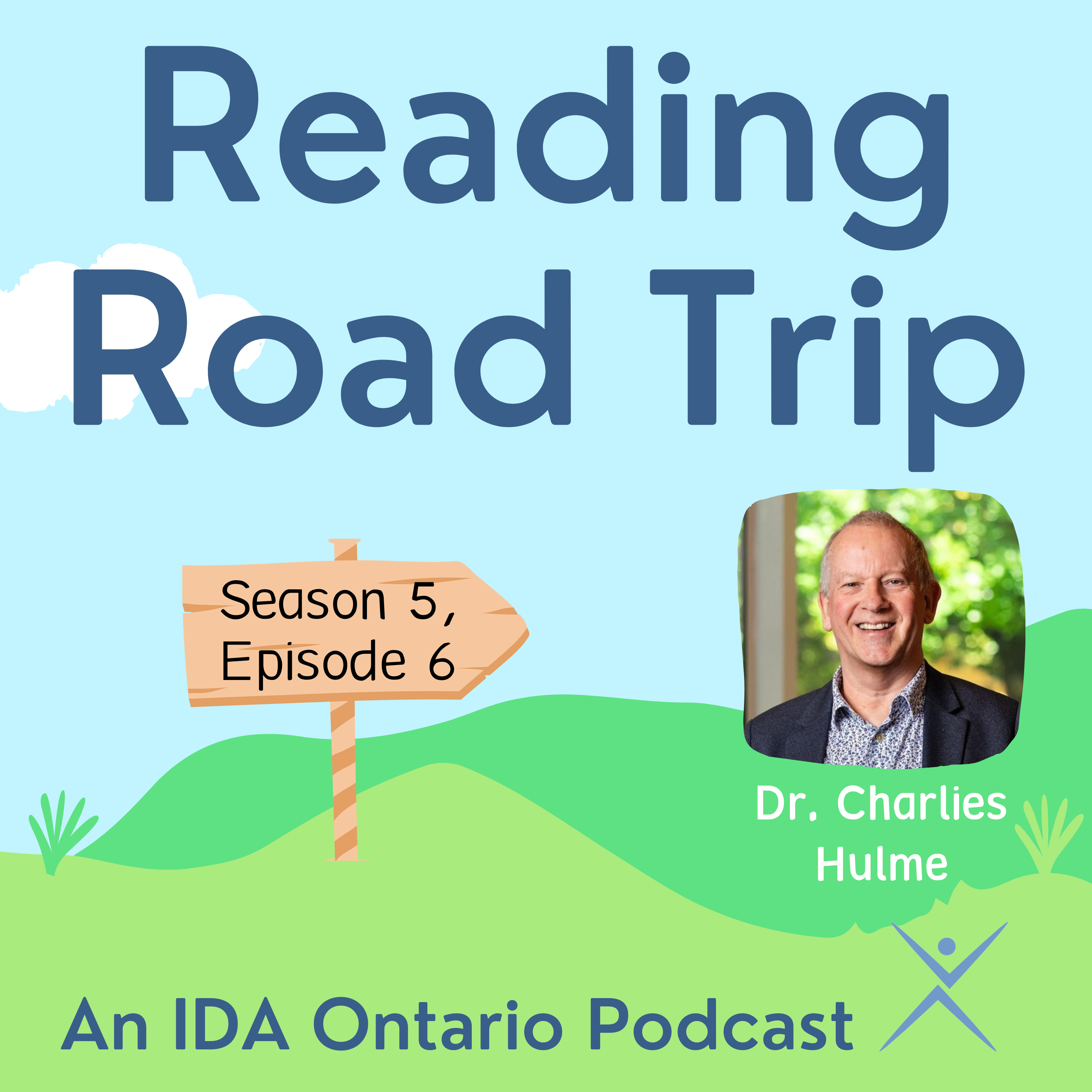
[00:00:05] Kate Winn: Hello to all you travelers out there on the road to evidence Based literacy instruction. I'm Kate Winn classroom teacher and host of IDA Ontario podcast Reading Road Trip. Welcome to the sixth episode of Season five.
Our work at IDA Ontario, which is a registered charity, depends on the generosity of people like you. If you find the podcast helpful, please consider supporting our organization.
Before we get started, we would like to acknowledge that we are recording this podcast from the traditional land of the Mississauga Anishinaabe. We are grateful to live here and thank the generations of First Nations people for their care for and teachings about the Earth. We also recognize the contributions of Metis, Inuit and other Indigenous peoples in shaping our community and country.
Along with this acknowledgment and in the spirit of truth and reconciliation, we'd like to amplify the work of Indigenous artists and today we are sharing the picture book Storyteller Teachings From My Ojibwe Grandfather by Lindsay Christina King, illustrated by Carolyn Frank have you ever wondered why rabbit has such long ears? Or why raccoon is wearing a mask? In this collection of funny and unique short stories, you young Skye enlightens us in a number of Indigenous teachings passed down to her from her Ojibwe grandfather. Through her natural gift of storytelling, Skye encourages other children to embrace the art and become storytellers too. Add this title to your home or classroom library today.
I would also like to give a special shout out today to Susan, a tutor who works at the Perth Library. She wrote to us asking for the Reading Road Trip logo image to print for an amazing book display she has up in the library saying have listened to every episode of Reading Road Trip. I really love the first series and have listened to them three times. The podcast is perfect for listening in the car. Thank you for your support Susan. Good luck with all of your work. And there is a photo of her display in the show notes for anyone interested in checking it out.
Now on with the show.
It is such a pleasure to introduce our guest here this week on Reading Road Trip. Charles Hume is Emeritus professor of Psychology and Education at the University of Oxford University. Charles has broad research interests in reading, language and memory processes and their development and is an expert on randomized controlled trials in education. He has published widely and is in the top 2% for citations of all researchers in the field of education.
He holds an honorary doctorate from the University of Oslo and is a member of the Academia Europea and a Fellow of the Academy of Social Sciences. He was elected a Fellow of the British Academy in 2017. Welcome, Dr. Hume.
[00:02:51] Charles Hume: Thank you, Kate. Very nice to be here.
[00:02:54] Kate Winn: And I'm really pleased about our topic this week. It does not get enough attention. It's starting to kind of make its way into people's consciousness. But the idea of oral language and that importance in education.
So the first question I want to ask you is for educators who have spent the past few years diving into the science of reading, where does oral language fit into that picture? And I know you argue that spoken language does deserve more attention than it often receives.
[00:03:21] Charles Hume: Yes. Okay, that's a very good question.
Should we start by saying a little bit about what we mean by oral language? We mean a child's ability to understand what's said to them and their ability to express ideas and thoughts they have using their own language. Those are sometimes called receptive language skills and expressive language skills.
If we talk about reading or literacy more broadly to begin with, our recent research suggests that oral language skills, particularly measured in the years just before children go to school and in the first couple of years of them being at school, are very closely related to how well children learn to read.
Now, it used to be thought that language was important for reading comprehension only, but in fact, our recent research and that of several other people now as well, suggests that in fact, these early oral language skills before children get to school actually provide the foundation for the development of what we call code related skills. Learning the relationship between letters and sounds, learning to identify sounds in spoken words, which in turn form the foundation for children's ability to learn to read words.
So the argument is that oral language is critical really for all aspects of the development of literacy. But if we say, okay, well that's great, what about the rest of education? My argument is that oral language skills actually are essential for the whole of formal education.
If you think about what happens in school, teachers are talking to children, they're explaining things to them, and children are listening to the teacher, understanding the teacher and remembering what's been said to them. But without good language skills, children won't understand a lot of what's being said to them and they won't have the language they need to be able to re express the information that they have learned from the teacher. And we call language, or a term we can use in relation to language. Here is the medium of instruction. What is happening in formal education is that people are speaking to you. You're listening, you're understanding, and you're learning from, from the language that you're hearing. And that goes from the earliest stages of being in school. Right through to university. What happens in university most of the time?
Well, speaking for myself, most of the time I went to lectures and there was a lot of complicated language about complicated topics. And I wrote notes about what the lecturer was saying. And that form of education absolutely depends upon language as the medium of instruction.
[00:07:11] Kate Winn: When we say oral language, there are a lot of different skills that are kind of encompassed there. You know, I'm thinking vocabulary, grammar, listening comprehension, narrative language, conversation. Do we know which aspects matter most for later reading success or are there aspects that matter more than others?
[00:07:29] Charles Hume: That's a really good question. I think the answer to it is both simple and complicated. The first thing to say, I think, is that language undoubtedly is a very, very complicated skill. And it's probably one of the things that's most unique to us as human beings having language. However, and as you've just said, if we think, if we talk to a linguist about what is language, they'd say, oh, it's a lot of things. It's knowing words, it's vocabulary knowledge, it's understanding the grammar of sentences, it's being able to use. Use language appropriately in a social setting, which we sometimes refer to as pragmatics. However, all of that's true, and I don't want to dispute any of that.
But when we try to measure language, which we do with a variety of standardized tests, the evidence suggests that languages to affect first approximation, what we as psychologists call a unitary trait. And what we mean by that is that some people have very good language skills and they're good at all aspects of language. Other people have average language skills, they're okay at most aspects of language. And the people we're most interested in are people who have really poor language skills. But if you, when you're measuring language, you, if someone has poor vocabulary knowledge, they probably have poor gram grammatical knowledge as well. And they'll have poor ability to express their thoughts because of language weaknesses, and they'll have problems in understanding narratives. So all of these different aspects of language, which in principle could be separated in practice, tend to coalesce together.
So, so I say it's a bit like if we're measuring people's height, you can't be tall in different ways. You have a certain height. You've got, you know, some people are very short, some people are average, and some people are very tall.
Language is a little bit like that. I don't want to exaggerate this, but when we use tests to measure language, they suggest that children tend to be good at many different aspects of language or poor at many different aspects of language.
[00:10:28] Kate Winn: Thank you. So you mentioned measurement and reading assessment is definitely an area of fascination and interest for me. I feel like teachers know much better now how to assess, especially that word reading component of word recognition, the phonemic awareness, the decoding. Oral language can feel much harder to measure. So I'm wondering what should classroom teachers, a lot of classroom teachers in our audience, what should they be paying attention to when they're observing and assessing young children's oral language? And what tools are available to them to use to assess?
[00:10:59] Charles Hume: Sure. Well, because I believe oral language is so important for literacy and indeed for all aspects of education, a few years ago, we developed a standardized test which is now been put into an app that allows school staff, or really any adult to use an app called Language Screen to. To quite quickly and accurately assess the level of a child's language skills. So in that app, a teacher would have four different measures that consist of this overall assessment.
A measure called expressive vocabulary, which is naming a series of pictures, some of which are quite unusual and unfamiliar to young children. A measure called listening comprehension, where the app reads a short story or a series of short stories to the child and asks them questions about what's happened in the story. A measure called sentence repetition, where the app says a sequence of sentences starting with very short sentences and the child has to repeat these sentences verbatim. And finally, a measure called receptive vocabulary, where the child hears a series of words and has to choose one of four pictures which matches the word that's spoken.
Those four measures actually hang together very well. Statistically, they correlate with each other very well. And the app gives an overall standard score for a child's level of language skill in relation to their age.
So the reason we developed this test was to give teachers a tool that they could use without further training, as I say, to get a quick but importantly accurate assessment of a child's level of. Of both language comprehension and language production.
[00:13:37] Kate Winn: And is this an app that schools or boards would purchase then for their educators to use?
[00:13:43] Charles Hume: It is. It's available on an annual license from our company, which is called Oxed and Assessment.
[00:13:55] Kate Winn: Okay, thank you. Many classrooms include lots of great oral language things. There's lots going on. Discussions and read alouds and partner talk. What distinguishes everyday classroom conversation from instruction that's actually likely to accelerate oral language development? I'm just thinking again about those teachers who are listening. What are some great high impact instructional routines that they could use? And I mean, I teach kindergarten, so Obviously, the early years are important to me, but does that differ? Are there things for teachers to do in older grades as well?
[00:14:26] Charles Hume: Yeah, that's a good question. I think our approach to language teaching has been very structured, and I suppose it's probably important to realize that language is something that can and I believe should be directly taught in school. And I guess I think there's a difference between normal conversation, where there's a lot of redundancy in what's said, and there's a lot of very rich contextual information around what's being said compared to more.
If you like abstract language, where you may be talking about something that isn't there in front of you. If we were having a conversation about what you wanted a child to do with something on the desk, the thing you're talking about is there on the desk, and you're just saying, you know, pick it up, take that apart and put it into the. To. To the box or whatever. That's easy to understand. But if you're talking about a story with people who aren't there and with events that you can't directly see, language becomes much richer and more complex and needs to be more explicit.
I would say it's very important to spend time giving children rich stories to listen to, but then engaging with those children in conversations about those stories.
There's a lot of evidence, and this is something that our language interventions make great play of. There's a lot of evidence that getting children to produce language is a very powerful way of improving their language skills. If I want to learn a foreign language, I'm a bit old for that now, but back in.
[00:16:41] Kate Winn: Never too old.
[00:16:42] Charles Hume: When I was learning French at school, it's much more powerful to learn a language by trying to speak and having people give you feedback when you make errors than simply relying on listening to language. So of course you need to listen to language, but there's very good evidence that language production is important for. For language learning.
So I guess one message from that is that teachers should be giving children, I know this is difficult in a whole class setting, but teachers really should be giving children more opportunities to speak in the classroom. I'm not talking about everybody shouting all at once, but asking different children to respond to. To questions, giving the children time to respond, and giving children what we call scaffolding or feedback that takes what the child has said and tries to adjust and expand on what the child has said to point out how what they've said could have been more complete or more grammatically accurate. So I think those are some of the main things I would say.
[00:18:13] Kate Winn: Yeah, yeah. So in the classroom, I know, like, we do a lot of, you know, elbow partners and I'll give a prompt and they're sharing with each other. So if I'm understanding correctly, it sounds like that's good because there's kind of some quantity of them having to express, but that we don't want to overlook the actual teacher feedback piece as well. Right. Because if they're all just working in pairs and not necessarily getting any expert feedback, we want to make sure that we're also allowing our opportunities for us to be hearing the children and responding and giving that error correction.
[00:18:42] Charles Hume: Yes, absolutely. So having children talk to each other is good. I wouldn't say don't do that at all. That's very good. But particularly for kids who are having language difficulties, there might be a really important role for teachers to try to spend more time engaging in a dialogue with those children and using what we call scaffolding to expand what those children say to the teacher and improve it.
[00:19:17] Kate Winn: And I'm all about using data to inform our instructions. So, you know, the information we get from screening may tell us which students we should prioritize if we can't get to everybody for that sort of situation.
[00:19:30] Charles Hume: Yes. That's really why we developed language screen. The best evidence is that somewhere between 7 and 10% of children have what we might refer to as clinically significant language difficulties. So that means there's probably two or three children in most classrooms who have language problems.
I should say these aren't evenly or fairly distributed throughout the world. These problems are much more common in children who come to school from disadvantaged or relatively deprived homes. But if we think that there are two or three children in each classroom on average, who might have clinically significant language difficulties, that's why something like language screen becomes so important.
Because, of course, many children with language problems, you know, the child who sits at the back of the classroom and is quiet and isn't disruptive. Some of those kids may be understanding very little of what is being said to them in the classroom. And a tool like language screen allows you to identify those children and then pay extra attention to them, I suppose, and more broadly, gives you a very good overview of the range of language skills that approach present in the children that you are teaching. Yeah.
[00:21:21] Kate Winn: I'd like to talk about dyslexia for a moment. So I thought it was interesting. Earlier in our conversation, you talked about oral language. I know a lot of our listeners are familiar with The Simple View of Reading or Scarborough's Reading Rope and the idea that oral language isn't just about the language comprehension piece. You mentioned how it can be connected to code. And our podcast comes from International Dyslexia Association, Ontario. I know that many educators think of dyslexia primarily as just a decoding or decoding spelling difficulty strictly connected to print. But how does oral language fit into the prevention and support of reading difficulties? Where do you see the connection between language weakness and dyslexia?
[00:22:01] Charles Hume: Yeah, that's a really excellent question. Well, the first thing to say, I think, is I would agree with you, and probably what most of your listeners believe, which is that dyslexia is really a disorder of the transcoding of print into speech. So dyslexia is really a problem in understanding the way the Alphabet works to represent the sounds of speech in printed words and how you go from the letters in a printed word to the sounds in a spoken word. And, of course, that also goes the other way in spelling, going from the sounds in a spoken word to the letters you need to use to write that word.
So that's what dyslexia is. It's about this, what I call transcoding of print into speech. Another way of saying that, though, is that reading is no more and no less than the representation or the understanding of how spoken language can be represented in vision or in print. And the research that we did, particularly a study that we published in 2015, showed that when we took a large sample of children who were at family risk, that is, of dyslexia, that is, children who had a parent who was dyslexic, and we also had a group of children who had preschool speech and language difficulties. And we took children who had no known difficulties at the time. And we started this study in preschool when the children were around three and a half years of age.
What we found in that study really surprised us, which was that the strongest predictor of who was going to go on to become dyslexic when they were eight years old was their level of language skill in the preschool years.
So having a language weakness before you enter school is a very, very strong predictor of whether you're going to become dyslexic. And I would say that the evidence is that many children who have dyslexia have broader language difficulties as well. And so dyslexia can be reduced, we believe, by starting to intervene early before children start to learn to read to improve children's oral language skills.
It is true that, I mean, I spent probably the first 20, 30 years of my career studying children who you might describe as classically defined dyslexic children. These were children who were really very bright and who had very severe problems in learning to read. Now, for some of those children, they probably had language difficulties before they entered school.
But for some of those children, particularly children from advantaged homes, they may overcome their early oral language difficulties, and they may end up with a really rather restricted phonological difficulty, a problem in dealing with the sounds of speech in a rather specific way.
But the typical child with reading problems actually has much broader language difficulties. And of course, in many people who have what I've called the classic dyslexia profile, that is high iq, severe reading problems, many of those people will have, for example, word finding and naming difficulties, which can be quite subtle, actually.
But you know, I often meet adults who are intelligent and can talk well, but might have some to use a long word. People who use, who have malapropisms in their speech, they say a long word and they don't say it quite correctly. People who may have some problems with name retrieval.
Those are residual language problems that are, you know, if, if I meet an adult dyslexic, most of them, I would say, have these residual really subtle problems with producing language which reflect a rather fuzzy or wonky representation of words, sounds and meanings.
[00:27:53] Kate Winn: That's so interesting. Your research has shown impressive gains from structured oral language intervention. So what are the characteristics of interventions that seem to make the biggest difference? And are there things that the classroom teachers can incorporate even if they don't have access to a formal intervention program?
[00:28:13] Charles Hume: Yeah, so we've now developed a whole set of language interventions. We've developed both what we call pull out or targeted intervention programs and also whole class programs.
I guess those programs in the US called TELL TED and in the UK we've called them nelly. These programs essentially work on three aspects of language. I would say there's work on direct vocabulary instruction, there's work on listening comprehension, and there's lots of work on children's narrative skills. What we mean by narrative is getting children to produce language, usually using picture prompts. So for example, you might show a child a sequence of pictures. This is for children, let's say five to six year old children.
Well, say four to six year old children. You might show children two or three pictures that represent a simple story and ask the child to say what the pictures are showing. That's a way of getting children to produce language. You can then give them feedback on what they produce using this technique called scaffolding.
The program spent pays a lot of attention to teaching children to attend to language, to listen when they're being spoken to, to look at the teacher when the teacher is speaking, and to only speak when they're asked to speak. So but there is a lot of work in both of these, in both the whole class and the pull out programs in placing an emphasis on getting children to produce language, not just to listen to it.
So I would say for teachers, spend time talking, probably mostly here, about the first few years of formal education. Read children good stories with rich language, maybe spend time explicitly teaching some of the vocabulary that occurs in the stories. Get a powerful way of getting children to learn new words is then to get them to use the new word in a sentence of their own creation.
So there's very good evidence that practicing using new words in different contexts supports the acquisition of a deeper and richer understanding of a newly acquired word. So those are elements that teachers I think could incorporate even if they don't have access to a formal or scripted program.
But we've put a lot of work into creating scripted programs which we believe are very important because essentially they take some of the burden off the teacher. The teacher is given the materials, they're given training in how to use the materials.
And what I've just described. To do it well would require teachers to spend a lot of time creating their own materials, selecting their own stories, identifying the words they wanted to teach from a story, etc. Etc.
We've done all of that work for the teacher and kind of put it in a can. And we think that makes it much easier for teachers then to do this high quality language work with their classes.
[00:32:49] Kate Winn: Another exciting finding from your research is that the benefits of strong oral language intervention can actually last for years. So why do you think that is? And what do we know about the importance of intervening early when it comes to oral language?
[00:33:04] Charles Hume: Yeah, so I would say intervention is important.
I would say language intervention or language teaching is something that ideally would start in preschool and continue for most of the primary school years. I mean, that's, that would be my ideal.
And I'm not sure that I want to say you need to start early. I think starting early is good, but you could be doing this later and it would still have effects. I don't, I'm, I'm not who believes in a, in a what, what people used to refer to as a critical period. You know, if you haven't learned language by the time you're four, you'll never learn it. I don't believe that you carry on learning language through a very long period of development.
So let's think of language as being important. Let's do high quality language work with children starting in preschool and continuing through the primary school years.
Why does that work show enduring effects?
I think certainly for the work we've done with children who have received these targeted language interventions, it works because we produce, to use a rather long word, what psychologists refer to as.
It has what. What we would refer to in psychology as metacognitive effects. It changes the way the children are thinking about language and it changes the way they're engaging with learning language.
So if you take a child who's having a lot of trouble learning language and you put them in a situation where you teach them language very explicitly, and one of the things you might say in a program like that is if you don't understand a word, ask someone what it means.
And you know, this is very complicated, but you potentially take children who are kind of passive and feel disaffected and disengaged from learning language to making them more engaged with learning language and giving them clear feedback and clear evidence that actually if they engage with language and try to learn it, they can learn it. So I think that's why these programs have enduring effects, because I think these children then carry on learning language better as more active learners than they would have been if they never had that sort of language help to begin with.
[00:36:15] Kate Winn: Well, this has been such a fascinating conversation for me. Is there anything that you want to share with listeners that we haven't talked about yet? Any final words or, or do you want to direct them to where to find your work?
[00:36:26] Charles Hume: Oh, I would just say in the early years.
There's nothing more important for early years education than rich language instruction. And I would say we need to move away from the view that when kids get to school, all you need to do is teach them to read. You do need to teach them to read, obviously you need to teach them arithmetic, you need to teach them a whole range of things. But actually language is the foundation of most of what you're trying to do in preschool and the early school years.
So pay attention to language. Talk to children using rich language. Give them time to talk back to, to you and have convers. Conversations are good words, isn't it? Let's have lots of conversations with our children. And yeah, you know, as I say, for me, language is the. Is at the heart of education. So pay attention to it, cherish it, nurture it in the children that you're your teaching.
If people want to find out more about my work, if they google my name, there aren't many people called Charles Hume on the planet.
They'll probably find a variety of information about me. They could look at something called Google Scholar, which lists all of my publications and most of the things I've written or or many of the things I've written are available free of charge from from from various journal websites. And also if you google my name, you'll probably find lots of webinars and things like this where I've talked about my research.
[00:38:30] Kate Winn: And if people are interested in the language screen app or your programs, where can they find them?
[00:38:35] Charles Hume: Those okay, if they just Google oxed. That's oxed, that's our company's website and you can anybody in the world can get language screen free of charge for, I'm not sure, a small number of weeks and try it out in your school and see if you find it useful without any charge. If you want to use it for longer you you would need to pay for it. But anybody can register for a free trial.
[00:39:08] Kate Winn: Okay, we will make sure to link to that in the show notes as well.
[00:39:11] Kate Winn: Dr. Charles Hume, thank you so much for being here for this episode of Reading Road Trip.
[00:39:16] Charles Hume: My pleasure. Thank you.
[00:39:21] Kate Winn: Show Notes for this episode with all the links and information you need can be found at podcast ida on ontario.com and you have been listening to season five episode six with Dr. Charles Hume.
Now it's time for that typical end of the podcast call to action. If you enjoyed this episode of Reading Road Trip, we'd love it if you could rate and or review it in your podcast app as this is extremely helpful for a show and of course we welcome any social media love you feel inspired to spread as well. Make sure you're following the Reading Road Trip podcast. You can you don't miss a single episode in this jam packed season. New episodes will be released on Monday mornings all summer long.
This podcast and all of IDA Ontario work is made possible by our dedicated volunteers including our hard working board together with our wonderful staff and supporters like you. If you'd like to support our work, please consider making a donation. You'll find the link in the show Notes.
I'm Kate Winn and along with everyone at IDA Ontario, we hope this episode of Reading Road Trip has made your path to evidence based literacy instruction just a little bit clearer and a lot more fun.