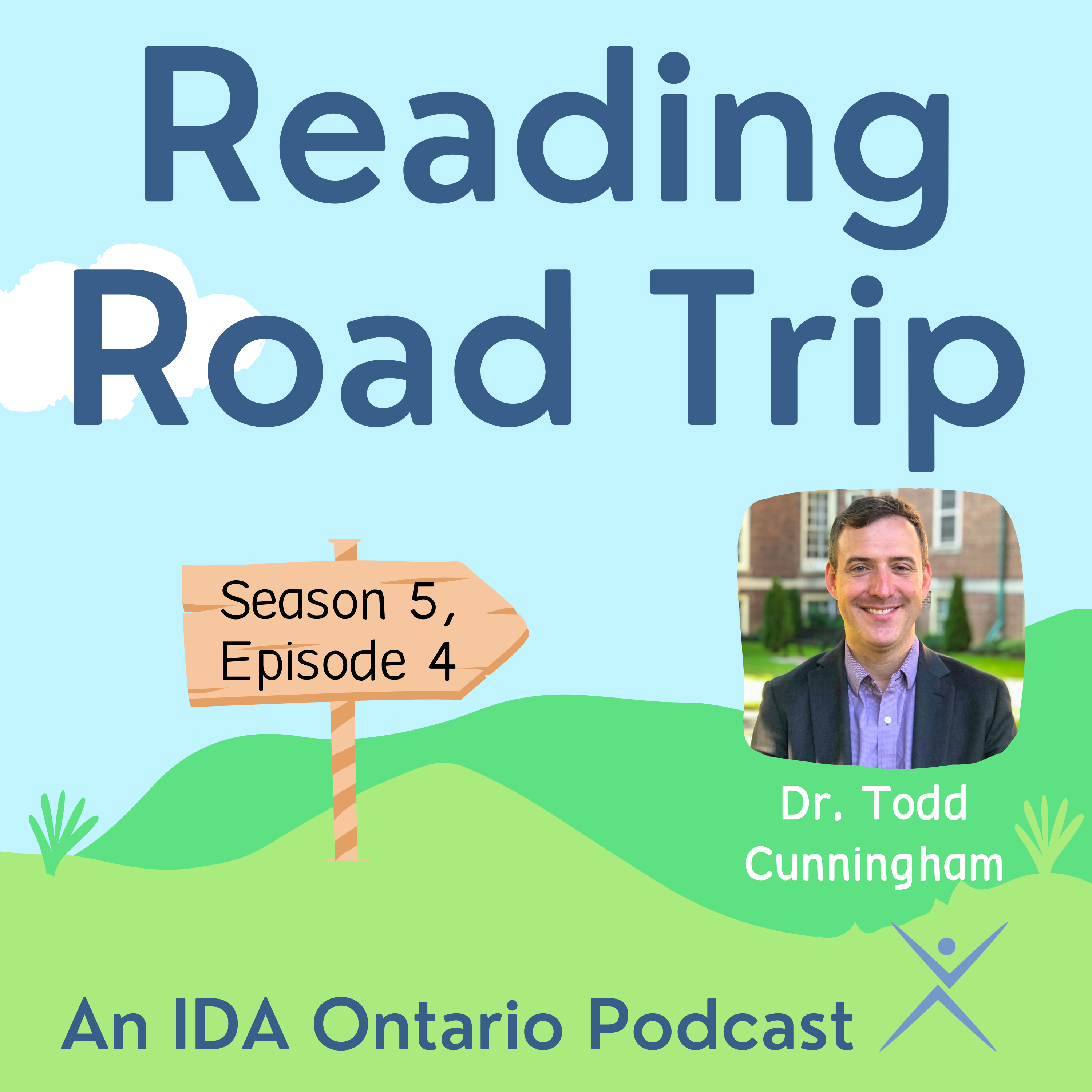
[00:00:06] Kate Winn: Hello to all you travelers out there on the road to evidence Based literacy instruction. I'm Kate Winn classroom teacher and host of International Dyslexia association of Ontario's podcast Reading Road Trip. Welcome to the fourth episode of Season five.
Our work at IDA Ontario, which is a registered charity, depends on the generosity of people like you. If you find the podcast helpful, please consider supporting our organization.
Before we get started, we would like to acknowledge that we are recording this podcast from the traditional land of the Mississauga Anishinaabeg. We are grateful to live here and thank the generations of First Nations people for their care for and teachings about the Earth. We also recognize the contributions of Metis, Inuit and other Indigenous peoples in shaping our community and country.
Along with this acknowledgment and in the spirit of truth and reconciliation, we'd like to amplify the work of Indigenous artists. And today we are sharing the children's book the Corn Chief, written by Karen Weitung with photography by Lindsay Deleron.
With the wise and old chief set to step down, young Linny dreams of being chosen as his replacement. As she struggles to pass his test, Linnie learns with the help of her family what it really takes to become chief in the most unexpected way.
This story is told with the help of traditional corn husk dolls. Corn dolls protect the home, livestock and personal wellness of the maker and their family. Corn husk dolls have been made in some Indigenous cultures since the beginning of corn agriculture more than 1000 years ago and continue to be made today.
Add this title to your home or classroom library today.
Now on with the show.
[00:01:47] Kate Winn: I'm so excited to welcome our guest here this week on Reading Road Trip for a podcast episode all about dyslexia. Dr. Todd Cunningham is a clinical and school psychologist, associate professor, teaching stream, and chair of the School and Clinical Child Psychology Program at the University of Toronto oise. His work focuses on learning disabilities, literacy assessment, assistive technology, and evidence informed intervention. Since 1999, he has delivered more than 700 presentations and workshops to educators, clinicians, families, school boards, professional groups, and government audiences across Canada, the United States, and internationally. Todd is also regularly consulted by major media outlets including cbc, ctv Global News, the Toronto Star, and radio, and now here with us on Reading Road Trip So he is joining us to share his expertise on dyslexia from both a professional and personal perspective. Active welcome Dr. Todd Cunningham.
[00:02:43] Dr. Todd Cunningham: Well, thank you for having me.
[00:02:45] Kate Winn: Let's just jump right in. So, for listeners who may not know your story, could you tell us a little bit about Your own experience growing up with dyslexia.
[00:02:55] Dr. Todd Cunningham: So, you know, like so many others, you know, it really starts off back in kindergarten, grade one, when my. I know my grade one report card came home, and my mom received the grade one report card and looked at it and it said that Todd knows his ABCs. And my mom kind of looked at me and says, I don't think Todd does know his ABCs. Dropped me down on the kitchen table and says, Todd, say your ABCs. And I was like, abc.
And so she goes, I knew it. The guy doesn't know it. But yet on the report card, the teacher says, he does so drag me and drop me in from my grade one teacher. And. And said, Todd doesn't know his ABCs. But yet you're on your report card. You're recording that he. He does know them. My great one teacher is like, Todd, say your ABCs. And I was like, ABCD. FDA ran them all the way off to Zed. And my mom thought this was weird. Can do them in school but can't do them at home.
What's up with this? And so she kind of saw what I was doing, so turned me around in the chair and said, Todd, say your ABCs. Again. I was like, abc.
What was. Was I was using a prompt. On the classroom was written the abc. So why call those silly letters when I could simply get a nice visual prompt? So from an early age, started looking, using strategies to hide the fact that learning how to read was something that was very, very difficult. And because it was this nice guy and relatively intelligent, most people kind of just push me along. And it really wasn't until grade 5 and that I really. School would just hit a point where it was so overwhelming, having so many challenges, teachers really didn't know what to do with me, that my parents actually pulled me from school for a year and homeschool me. And during that year, I got my first formal assessment done to kind of identify that, yes, in fact, Todd does have this challenge with processing letters and numbers. And that's what we call dyslexia.
And that really began. Well, the hope was that was going to change things around, but unfortunately, it really didn't. And so it wasn't until I got to grade nine that I actually had an amazing teacher who really didn't understand what to do with me, but understood that we needed to do things in a different way and really began to be my advocate within the school system that to be able to try and help teachers to look for alternative ways of doing Stuff. So when my history teacher used to penalize me due to the ferocious spelling that I had, she went and talked to him and finally came up with a new way of kind of working around the spelling because he used to joke with me saying, todd, the way that I mark your tests and assignments is I use the cat litter box marking scheme. I put your tests in the cat litter box, and if my cat pees on it overnight, you fail the test. And if my cat doesn't pee on it overnight, you pass the test. The reading. The reason being he couldn't read my bad spelling. And so she said, cat litter box, you know, marking scheme, that's a bad rubric, needs at least four levels. We're missing about two. So, you know, how do we, how do we kind of work around this? Where are the accommodations that, that we can begin to set. Set in? So, and it was really wasn't until I got to university that I really began to find all the other kind of technology tools that were just coming on the market at that time to really be kind of the accommodations that allow me to work around my fantastic reading and writing challenges that have, have been there.
[00:06:37] Kate Winn: So you bring a perspective, as I mentioned, that is especially valuable because you have experienced dyslexia personally and work with it professionally. How personal journey shaped the way you approach your work?
[00:06:49] Dr. Todd Cunningham: Well, I decided to do it. So when I was at undergrad at Trent University, I was in the concurrent education program. They're going to be a teacher. And as I was sitting in teaching classes, I really felt like, oh my goodness. I was not getting like, I don't know how to be a teacher based on these classes. But when I was in my psychology classes, I was amazed by the knowledge that we had around how, how people go learning about reading, what reading actually is, the, the research that has come out of this, the long research that's been out there, and I was like, why are we learning this stuff in like, teachers college? Like, this is crazy. So as I was going through undergrad, I became fascinated by learning about how brains go about acquiring information.
And it got me excited to actually start looking at the actual empirical evidence out there. These amazing researchers like Stanovich and Swanson, Lovett Tolkiensen, who all became like, my read, my reading research heroes who I wanted to meet in life. You know, other people go for baseball players and basketball players. I went for reading researchers. I just was obsessed with these individuals because they were able to actually demonstrate what we needed to do within the classroom.
And so as I was into finishing Off Teachers college, I decided to leave that to go and work with one of them and actually onto a whole another journey where I decided to go into psychology instead.
So a lot of what I do now is to really think about, okay, we have this amazing set of knowledge, we have these amazing tools out there, we know what to do, we know how to do it, but how do we get it into the education system? How do we actually start to implement this evidence based knowledge so we can actually change the lives of other students so that they don't have to go through the same challenges that so many other students have gone through? How can we make a fundamental shift in the way that we're working with individuals? And one of the great things is we have a bit of a political move too at this point. So now the key areas is really working on getting this knowledge to frontline workers, the teachers, so that they can work with their students in a very effective way.
[00:09:05] Kate Winn: And that's what we're trying to do right here. And I also want to shout out the Trent Con Ed program. I went through that myself as well. So I know the teacher education stream exists in a different way there at Trent right now. I have two daughters, one already in it and one going into it in the fall. So it's a little bit different than it was when, when I probably was, but yes, but great, great university.
Has your understanding of dyslexia changed over time, even now as an expert in the field?
[00:09:32] Dr. Todd Cunningham: Yeah. So like, you know, when I was a kid, I knew dyslexia was I couldn't read and write.
You know, I tried to write an email to a girl one day and called her butt full being said beautiful. So, you know, that was very problematic.
Then it became into, okay, learning what it was. And during my time as being trained as a psychologist to where I am today, you know, there's actually been an evolution in our thinking about what dyslexia was. So we really went from a period of thinking about like kind of processing, cognitive processing, strengths and weaknesses. So at one point my dyslexia was called an auditory based working memory disorder. And now we think of it, we have a new evolution of our thinking about it where we're really seeing it as a symbolic processing. So what dyslexia is, is my brain doesn't process symbols the same way or as efficiently as someone else's brain does. So when I see letters and numbers on the page, it takes my brain longer to process that information versus someone else. So I can learn lots of cool Information out there. But these symbols that are very widely used in our society, they create a bit of an obstacle for my brain. And when we look at how our brains learn these symbols, our brains were not built to actually process symbols. Our brains were built on feature detection.
So when we see something like my, my phone here, you know it, I know that this is a phone, because as I move it in space, it stays a phone.
We have a part of our brain called feature detection that allows us to know a thing is a thing is a thing, no matter how we move it around. But when it comes to symbols, letters and numbers, well, as those shapes change, their properties change fundamentally. So you think of P, B, D and Q based on that stick and ball, their orientation have fundamentally different properties. And so the brain has to rewire itself to actually start to deal with these symbols in a way that it doesn't deal with any other physical objects in urban 2D objects in the world.
And so that's where our understanding is. It's really this kind of symbolic processing disorder that we're running into. And because our brains are having a harder time connecting symbols to knowledge and sounds, then it makes it hard for someone to learn how to read, because that's what reading is, is connecting symbols to sound to be able to get the words. But same with spelling. Spelling is the reverse process, is taking those sounds and words and turning them into symbols as well as basic mathematics. So knowing like 5 times 5 is 25 is the same thing as knowing dog equals dog. It's the same symbolic processing that's going on. And that's why we often see students who have dyslexia having difficulties in these three fundamental areas, Reading, writing, and math. Not that they can't understand what's being read to them, not that they have great ideas that they want to express or that they can do advanced mathematics. But those basic symbolic processes that start the foundation of the way that we interact with those three major areas, that's where that weakness is. And that's where the.
So that's where our knowledge is at this point. So when we think of dyslexia, it's really about the symbolic processing challenge. And how do we work around these symbols, either through teaching the brain how to process those symbols more effectively, or. Or how do we bypass that weakness so that we can get to those higher order skills?
[00:12:59] Kate Winn: Are there any myths or assumptions about dyslexia out there that you still hear frequently and that you kind of just wish would disappear?
[00:13:08] Dr. Todd Cunningham: Yeah, like, I think the biggest one is it's going to go away. Like, just give it some more time. Again, we know we can capture this at an early age. At the age of four, we can use screeners to be able to identify individuals who will be at risk for developing dyslexia in the future.
So we can start at a very early age to go in there. We know that when it comes to intervention, if we intervene by the end of grade one, we have the best, the most effective abilities to remediate, actually remove, fix the dyslexia, get that student to be a proficient reader. But if we wait to grade two, that drops. We wait to grade three, it drops even more. And we don't know what happens after grade four because we haven't done the studies yet. So we know that their early intervention is essential to be able to help out with, with teaching this. So this whole idea of I'll just give a little bit more time is misnomer out there. If we're seeing individuals who have reading weaknesses or writing weaknesses early on kindergarten grade one, we need to intervene as fast as, as possible because we have. The brain is, as it's developing, starts to lose some of its plasticity. Not saying that a person who has dyslexia cannot learn how to read later on in life, but they'll never be as fluent, never be as proficient as they could have been if we had done it at an earlier age. And so that misnomer is, is one of the challenging ones. The other big one is that you need a huge, large psychological assessment to be able to do this. Again, not needed. We have some very targeted tests. We know what to look for. We can do this in about 30, 40 minutes to get a very targeted assessment to say, yes, you meet the criteria for dyslexia and therefore we need to go and intervene with this individual. We don't have to wait for the 8 hour battery of tests that really doesn't provide that much additional, useful information.
[00:15:07] Kate Winn: We talk a lot here on our episode or on our podcast. But reading. And of course, you mentioned, you know, dyslexia can also impact writing and even the whole simple piece of math. Math. But dyslexia affects more than just academics. So how can it impact a child in terms of emotional, social, those sort of realms?
[00:15:24] Dr. Todd Cunningham: Yeah, so dyslexia itself doesn't actually impact it. It's how our society deals with people who have dyslexia.
[00:15:30] Kate Winn: Right.
[00:15:30] Dr. Todd Cunningham: That leads to all those things. So there's something called kind of the cascading effect that happens when you have a Found like a fundamental weakness in a skill. So if I'm unable to read and I go to school each day and you ask me to try and learn how to read, then most students are very well. Virtually every student I've ever met is highly motivated to try and learn and read. They want to look like everybody else. They want to be able to do the same, same things that their friends are doing. So they're very engaged in this process. But as they're going through kindergarten and grade one, and as they start seeing their other friends are being able to read and they still can't read, or their penmanship is really poor and they can't form their letters very well, then what happens is they start to get negative messages. They start getting messaging from teachers to try harder, to try harder, keep going at it. They start to see through what we call peer referencing. They start seeing that their peers are getting it and they can't get it. And so that starts having an impact on themselves. And what we know in the literature's something called the Stan of it or the Matthew effect, the richer get richer, the poor get poorer. As we start to go into grade one and grade two, you know, those who are able to read and like to read, what they actually do in their free time is they actually read more and more and more. And because they're reading more and more and more, they're actually getting more practice, they're getting more time on task, actually developing the whole reading network. Whereas those who are struggling with reader reading, guess what they do on their free time? They go out, have fun, they're playing outside, they're playing with Lego, they're doing other great stuff. And so the they're just not getting as actually the same amount of practice. So it's an area of weakness, and they're not getting the same amount of practice on it. And so their skills, though still developing, don't develop at the same rate as a proficient reader. And that gap gets bigger and bigger and bigger. And by grade three, grade four, what we see is this kind of change that begins to happen where in school we're really teaching you how to read up to grade three, and from grade four onward, you really need to know how to read, continue to, to learn.
So we run into this issue where students are really motivated to try and do this, but they just can't seem to get it. And motivation is my intent, my intent to do something.
However, engagement is my ability to actually do it. And so if I'm motivated to do it and I try to engage in the learning process. But I keep having failure after failure after failure. Well, I can't actually engage in that. And if I can't engage in something over and over and over, then my motivation starts to take a real hit. And so I start to say, why am I doing this? Why am I trying to do this? This is like a waste of time. And so I start to avoid those things as well as I don't want to look stupid in front of other students. So I will avoid a lot of tasks. So a lot of the behaviors we start seeing emerging around grade three, grade four for is a lot of avoidance behaviors. Kids are avoiding things that are really hard for them. They don't want to stand out, they don't like to do it, and they don't want to look silly in front of their peers around them. And so this is where a lot of those behaviors come on. The second set of behaviors that we start to see is what we call academic self concept begins to drop. So academic self concept is, how do I view myself as a learner? I have high academic self concept, I think I'm a great student. If I have very low academic self concept, I think I can't learn. I'm a lousy student. And what we see is, we see a real decrease in academic self concept within students who have dyslexia, again with grade 4, 5 period, where they just don't believe that they're great students. They just don't want to try anymore. And so they start internalizing a lot of this guilt blame onto the self. I'm a bad student. I'm stupid. All my friends can do this stuff. All my friends can learn out there. I, I can't learn. Why am I trying? Why am I start to do this? And so this is where we start seeing all the secondary issues come on. Low academic self concept, low self esteem, higher rates of depression and anxiety beginning to emerge. And it's not that those are initially part of the disorder, but because you have dyslexia and because you have a system that doesn't intervene at an early age, that then we actually create the real disability as you're going through.
And there was a fantastic set of research that was done in Canada back in like 2009, where they looked at kind of the, the learning disability dyslexia population versus the typical population. And what they found is in terms of adults 18 years or older, they found that students who had profound reading challenges were more likely to be underemployed, more likely to just not be trying to get a job at all and had significantly higher rates of poor mental health and having significant rates of poor physical health as well. So this wasn't just, you know, dyslexia is just not a school related disorder. It's something that does travel through their life. It has a profound impact on individuals as they, as they get older. And so it has a real impact on quality of life long term. So again, going back to this need for us to really understand what the, what dyslexia is and that we have the assessment tools, we have the screening tools, and we have the knowledge how to intervene at an early age, like it really does, by doing these things, we can have a profound impact on the life trajectory of an individual. Again, a slight piece of neural wiring is just harder to do back in kindergarten, grade one. And if we don't do it, address that and we really create a lifelong disability for an individual.
[00:21:19] Kate Winn: Well, my next question is going to relate to parents, but what you said about self concept made me think of an Ontario parent I was talking to recently and she was talking about how her child at the age of five would come home saying that he was dumb and he wanted to die.
And the thought of, I mean, I teach kindergarten. The thought of a five year old coming home and saying that just breaks your, your heart. He did get his dyslexia diagnosis at 7, which is earlier than a lot of people might get it in terms of when that diagnosis comes. I think sometimes it's a relief for kids, for parents to know that there's a reason, that there's something there.
What would you advise parents when they're first talking to their child about a dyslexia diagnosis? Or even for teachers who are addressing what dyslexia means in the classroom, what's kind of a child friendly way to talk about this? How much do kids need to know?
[00:22:13] Dr. Todd Cunningham: Yeah, I talk to the kids the way saying I talk to parents and teachers like, hey, your brains is having a harder time processing these weird symbols that we as humans decide to come up with. It does not mean that you can't learn. Hey, look at all the things that you learned. You learned how to talk, walk, you can tie your shoes, you learned video games, you learned all kinds of information out there. So you clearly can learn stuff. So this idea you can't learn is definitely a misnomer here. You can learn, but it's definitely, we can see that there is a very specific weakness in your brain. And if you want to touch them, you know, we actually Know where, where that wire is. Find your left side of your brain. Touch the very back. That's your symbol part just above your eye. Just back a bit. That's the sound part of your brain. And that highway that connects those two, there's something going on there that's making it harder for you process those, those symbols. And so we need to go in and train your brain to do that.
And until we do that, then we know that when it comes to you having to read, spell, do some basic math, write stuff out, you know that's going to be a lot harder for you to do. And so we're going to need to help support you both learning how to do that and if you're older, how to work around those challenges so that you can continue to learn the information that that is that's out there.
So I'm very open to just talk about, hey, this is how your brain is and we know what the challenge is, but we need to go in there and fix that so it doesn't continue to impact you.
[00:23:42] Kate Winn: Dyslexia doesn't just affect the individual child, of course it can affect the whole family, including siblings.
What are some of the realities from your experience that families may go through with a dyslexia diagnosis?
[00:23:56] Dr. Todd Cunningham: Well, again, often there's multiple phases or early phase is the child's having a lot of challenges and we don't know why, because we don't, you know, school has not done early screening or has not informed about that or waiting for it.
Parents are often, I hear, feeling very frustrated. They feel kind of combative with the school, especially in the early eighth grades, trying to get something done where they're kind of being told not to worry about it, push it on. And so the child often becomes a real focus. And at the same time that that child is also, you know, their academic self concept starting to go down, like they're having other impacts going on with them. So that child becomes a lot of focus and often that puts stresses on relationships in terms of what should we do, we don't know what to do. One parent might be advocating more than another parent. So that can cause internal rift within relationships. Um, there's also can feel jealousy from other siblings within the family relationship. If one parents with one siblings getting all the attention and all talking about, then other siblings might feel more left out or might even actually hide challenges that are going on because they don't want to add the stressors to the parents if they see their parents are already quite stressed. Kids are very good at Trying to protect other kids or protect their parents from the stressors in their life if they see a lot of emotional reactions that are going on. So it does bring a whole lot of stressors there. And then there might be financial stressors as well that begin to emerge. You know, know, try and get a psychological assessment if you feel like that's what you need to be able to try and get the school system to listen.
If the school's not providing the types of interventions that we're looking for, then, you know, going privately to get that all that stuff is quite expensive at this point. And it's going to tap on the. The family resources that are available both for the full family, for the other individual kids and what, what's going on and might again puts more financial stressors on. On. On the, the parents as well as they try to navigate through those financial stressors. So yeah, no, it definitely has an impact within the family, the full family unit that's going on.
[00:26:10] Kate Winn: Are there family routines or approaches that can reduce the stress around, you know, reading at school and doing homework and all of that sort of thing? I know a lot of parents say it feels like a battle in the evening to try to deal with all of that. And I'm thinking we have, you know, parents who might be listening from a parent perspective, but also my fellow educators who are trying to help support parents and give them tips and, you know, best approaches and things like that. What do you suggest again?
[00:26:36] Dr. Todd Cunningham: I always think when it comes to homework and that what's the purpose of the homework, like is there's actually a real targeted skill that I'm trying to develop. I see a lot of homework that my kids bring home and I think someone needed to fill a little couple more minutes in their class time to be able to get stuff done here. I'm not sure really what's being reinforced, forced in this assignment that, that that's being done.
So we need to have a real clear understanding of what is the purpose of the work that we're sending home. If it's just because they, you know, Johnny didn't get through all this stuff during the day and I feel like you need to do it at home. Well, that's not a great use of that time would be a better use of the time is to have something more targeted, saying, hey, if you are, if you have 15, 20 minutes this evening, it's better to be working on, you know, doing these reading activities or working on this writing assignment, something that's very targeted around kind of the skill Acquisition to be able to build up those reading, writing or math skills that the student might be having difficulties on and that the homework is going to progressively Kate Winn scaffold in a way that it's going to slowly get a little bit harder, a little bit harder over the course of the year to keep growing the set of skills. Because it is important for kids who have, you know, dyslexia that they should be practicing again kind of 15, 20 minutes a day outside of school on their, on, on those skill sets more. It's kind of going to the gym. If, if you only go to the gym once in a while and work out, then you're not going to really build up the your muscles. But if you're going on a regular basis doing something, then that's going to have a more long term effect. And actually the research has shown that smaller doses of practice, again, 15, 20 minutes a day over the course of five days is better than like one big two hour practice all at once. Because the brain fatigues and so again spreading that out over the course of the week can really help it. So what is the purpose of it? What are the tools that we're using that we're providing the parents to be able to help to support that information or that that skill develop? And the second thing is as a parent, do I have a good working relationship with my, with my child? If we are at a combative relationship, every time I sit down and my child is getting mad stressed crying and I'm getting mad stress crying, then that's we're probably not the best two people to work together. You know, that's when we need to think of who else is out there? Do we have a relative who can come in and help to do this? Is there a tutor or a high school student who can help out? How can we do this? Sometimes parents just need to stay as the parent. You know, we need to be the person they can come cry to, you know, cry. We can listen to them, help come up with a strategy and go and try and solve that problem. We don't also need to be the source of stressors that are going into their lives when it comes to something that is profoundly hard for them to be able to do. The best thing though for, you know, at any age is to read to our kids. You know, development of oral language, just talking, hearing stories, hearing vocabulary, all that stuff is fantastic. No matter, you know, if they have a dyslexia or not dyslexia, just constant exposure to oral language is fantastic. Getting Kids off of screens and just getting them outside to run around. Fantastic things. Those are battles that parents really should take, put a lot more effort into. Those are kind of things that gonna have more performance, profound impact on, on their child. And then when it comes to the nightly homework, I'd often ask my teacher, what's the purpose of this? Like, how is this helping? Let me see, where, where, how what you're doing in the, in the class and what I'm doing at home works together to be able to strengthen their reading or writing skills.
[00:30:25] Kate Winn: Parents often worry, you know, in terms of a child who's struggling with reading that, that they're doing something wrong. Right. There's always that, you know, what, what could I have done differently? Or what should I be doing differently? Or that missing something important. What do you want families to hear about that sort of role in, in their child with that learning disability, with dyslexia?
[00:30:44] Dr. Todd Cunningham: So the first thing is parents have take off. It's not, it's not their fault. Well, kind of is genetic. So you gave them, you gave your child a gene. So, but after that, environmentally you did nothing wrong. You know, this is just the way, just the right type of gene combination came together to be able to form this type of brain. And again, this brain is a brain that is just not dealing well with one type of learning out there. The symbolic processing piece out there does not say anything else about how that child's going to be be learning.
So reduce that guilt. Don't feel bad. The second thing is I tell parents, listen to their internal gut. Like if you feel something's up and something's wrong, then act on that. You know, we have that kind of gut reaction to no, that doesn't sound right, or I think something's going on here. This is not working out right. That's a good reaction to follow through and, and ask more questions about, and explore that and understand where that's going. Talk, start off at the school level, but maybe talk to them, move up to the principals, get, get out there, start talking and trying to gain some more information yourself.
General googling is not always the best way to look after that, but definitely trying to find other professionals or other support agencies to be able to help you to understand and explore what, what's going on to help you to make decisions about what to do next. I think that's really important.
Don't let others just to say, oh, don't worry about it. If you are really worrying about it, typically there's something else going on there that we need to, to explore that. So really do. Listening to that gut, I think is really important for parents to do.
[00:32:26] Kate Winn: Yeah. And I know I get a lot of messages, like people will just send me an Instagram direct message or you know, my child's teacher this or you know, like all of those sorts of things. And even just in terms of it's so important to try to communicate and have relationships with the educators, right where it is, it is your right as a parent. This is your child. If there is an issue, you do need to bring it up. And then also, just also having the respect for how you communicate with professionals. But then you just kind of have to keep pushing a little bit more, a little bit more like kind of that, you know, the whole chain of command like start with the teacher and then if, if it's kind of not going anywhere and you, then you need to take the next step, then take that next step as needed. Right. And just remember that it is all about your child, that you do have to advocate and, and kind of keep moving things along the line if, if you're not getting any, any action.
[00:33:14] Dr. Todd Cunningham: Yeah. And I find if the best practice places where school parent relationships work is when as a parent can go in and have a good conversation with the classroom teacher. Like honestly, you don't need the rest of the system often involved. If you have a good working relationship with a classroom teacher, then lots can happen.
If, if the teacher needs more support and stuff like that, then yes, let's bring in the principal. But quickly escalating something often brings in the bureaucratic system. And when the bureaucratic system often gets involved, then there's less and less kind of maneuverability that can happen at the classroom level. That happens, I find. So keeping it at that, as you said, keeping it at that classroom doing respectful way, knowing that teachers got involved in teaching because they generally care for kids and like, like watching students learn. So how do we, how do we capture. Capitalize on, on that to be able to work together to, to, to get these things and also know that there are limitations within our system. Our system does have limitations within it and sometimes the requests that we're asking are just beyond what a school can actually provide. So again, it's having those open conversations then with the school to find out, okay, what are alternatives that, that we can do. How else can I help navigate this?
Who are again reaching out to others to try and get inputs on what are some alternative ways to work around if the school is not able to, to be able to provide all of what we need.
[00:34:48] Kate Winn: Yeah. And, and like you said, going directly to the classroom teacher first, having that open conversation, not just going right to Facebook.
[00:34:55] Dr. Todd Cunningham: No.
[00:34:56] Kate Winn: And sharing your concerns. You know, start with us. Please. Talk to the teacher.
[00:35:01] Dr. Todd Cunningham: Yeah, yeah, very much so. Yeah.
[00:35:03] Kate Winn: Yeah. What do you hope that schools are moving toward in how they understand and support students with dyslexia?
[00:35:09] Dr. Todd Cunningham: Well, again, we have the knowledge, so we know what it is. We know the neurobiology of it. We know how to treat it, we know how to identify, screen for it.
We have political mechanisms these days in Ontario out there, which is great. So what my hope is is that we see more of that trickling down into this, into the classrooms. And I think the way that this is going to happen is really through community of learning that's taking place. Teachers coming together to actually work and build up their knowledge as a group. I'm not doing this on my own as a single teacher, but as a group of us really taking, taking this on. Because as we develop our knowledge, let's say just start off with dyslexia, as we start developing that knowledge, well, then that's also going to help out with a whole bunch of areas because reading, writing and math are impacted by a bunch of other disorders. Like if you have adhd, you often also have comorbid challenges in these areas. Now, the reason why that is might be a little bit different, but you're often going to have these different difficulties. And so we can support that student, student who has like a language disorder. Again, it's also going to have difficulties in this area. Now there's going to be again, additional things that's going to happen, be done for the language issues that are going on. But the reading, writing and math thing, still the same kind of interventions that we need to do to be able to support those students, students who just haven't had the same opportunities to learn due to lived experiences. Again, they're going to deal benefit from the same types of interventions that we're bringing in, same types of supports that we're. We're offering. So I think seeing those learning communities develop, I think are going to be essential in every school to really have. And yes, it'd be great if we had more structured programs from board levels coming down, but those seem to be a little bit slow. And so I think it's really going to be on the teachers as a group who are very knowledgeable individuals, professionals, to really kind of grow their knowledge as a group out there. And one of the big areas that we want to see that Knowledge growing is also in kind of MTSs, multi tier of systems of support. Because what we know from MTSS is when we do really good, what we call tier one general classroom teaching in the areas of reading, writing, math, mental health, social sciences, when we do really good classroom stuff, then we see about 80% of our students just learning, which is fantastic. And that's going to reduce the load on the teacher because now instead of trying to deal with a whole class, class of unique learners all over the place, now we got kind of a good solid group of them moving along and that gives us time to, then we'll look at the next 20% and of those 20% we're going to be able to capture well of the whole class, another 15% are going to just need some more intensive work. So kind of double the intensity of the learning that's taking place and we can do that in small groups. We can grab a couple of students aside and give a little bit more support to those individuals. And in doing that, it's really going to signal who are the students who really have the most profound learning challenges at the very top. And those are the ones that we can then quickly move on to remediation or really intensive remediation or assessment work.
So having an ability to actually use universal screening to actually make data based decisions, to be data informed, saying okay, yes, this is my main group of students here. Here are those weak students that I'm going to start to work with. I'm going to monitor those students. Okay, here's a couple of students who are not doing as well. Here's a group of students who are actually developing very nicely. We actually move them back into the regular group, giving me more time to work with this in smaller group. If we are doing that really well, I think it would actually free up teachers so that they could understand how to approach the great diversity that they see in front of them when they walk into the classroom to actually be able to say okay, in any given group.
I really have three to four groups here and here's how I'm going to triage and how I'm going to kind of perform plan for each of those different groups. And this is how I'm going to differentiate my instruction to those different groups to ensure that students are getting what, what they need right now. I often find that a lot of times people just feel overwhelmed. Oh my goodness, I have to teach all this. I have all these unique learners in my classroom. Where do I begin? MTSS gives us kind of that, that blueprint of how to move through using good database decision rules and matrixes to be able to find those groups, create those groups and then provide those groups with the instructions that they need.
[00:39:57] Kate Winn: Well, I love how your response highlighted a the use of screener data because we are here in Ontario right now and we know that from year two kindergarten through too, we are doing that early reading screening which is so important and also that you kind of empower classroom teachers to use that Tier one as our first line of defense, offense, whatever way you want to look at it. But that even as classroom teachers we can do small groups, we can do some intensification, right. And we might not be able to provide the tier 3 sort of intensity that a particular student might need. But there are things we can do with that data with some students who are at meeting benchmark even within our own classrooms. And then as you say, it also frees up even the those resources, the human resources who can then take on those really higher needs that we can't necessarily meet in the classroom. But there's a lot that we can do even in our own.
[00:40:49] Dr. Todd Cunningham: There's a lot. And again, you know, 95% of our population should be able to learn within the classroom either through tier one or tier two. And often when we talk about tier two, I know that we don't have clear definitions within Ontario in Canada about what these different tiers look like. But you know, when we look at a lot of the research really Tier two is about just re administering the same good instruction that happened at Tier 1 in a smaller group so that students to get more repetition on the task, they get more direct feedback from the teacher because it's a smaller group with it and, and just more practice, more time on task on on that that skill. That's really what Tier 2 is meant to, to be.
It doesn't have to be a whole new program somewhere else.
Tier 2 can be it. The other thing that none of the tiers take into consideration is accommodations. Accommodations works only at the Tier 1 level using assistive technology such as the computer reading out loud to you or voice recognition. That's not a tier 2 or tier 3. Tier 2. Tier 3 have to do with building up the underlying system skills. So actually teaching someone how to read or how to spell or do basic math. That's what what happens at tier two. Tier three. The second we get into any of the accommodations that all drops back to down to tier one. We're saying that what we're going to do is provide you with accommodations so that you can engage in the day to day the same type of learning that's happening in the regular classroom, which is defined as a tier one happening in that regular classroom.
And so therefore we have to think about when are we bringing in those accommodations. So if I have a grade two student, I'm probably not going to introduce assistive technology to them because they're still in that wonderful window to be able to benefit from intensive support. So I'm going to be giving them a Tier 2 intervention during reading period so that they can continue to develop that, that skill or move them onto a tier three. But if we're looking at grade 10 in, you know, then maybe I need to be using accommodations because I don't have time for an alternative programming to actually teach them how to read, unfortunately. And so therefore I'm going to provide them with assistive technology so that they can engage in that tier one work that's happening within the classroom so that they can continue to learn.
[00:43:10] Kate Winn: Well, and I did not tell you I was going to ask you about this, but because that just came up, the idea of accommodations I see online sometimes even just with, you know, grown women posting things about do audience audiobooks count as reading? And that sort of thing.
[00:43:21] Dr. Todd Cunningham: Right.
[00:43:21] Kate Winn: And so I think there's a line where of course you're a snob if you say you listened to the book, you didn't read it, like, of course you, you were exposed to the book, like, that's all fine. But when we're doing, using accommodations with students in our educational system, yes, that can help them access some grade level material we need them to access, but it doesn't mean we're not going to still teach them to read. So I feel like that's kind of an important, an important distinction that, you know, if people are listening to audiobooks, we're not going to say that's not reading. I mean, that's, that's my opinion anyway, because that, that just seems so snobby as, as adults to say you didn't actually read the book.
But I do find sometimes, especially in years past, it's getting better now. But it just seemed like we reached a tipping point where, oh, well, they're not going to learn to read. So we've moved on to assistive technology. It can also be they're not going to learn to handwrite. And so we are on to, you know, using speech detects, that sort of thing where it's like, okay, and now there's no more remediation, there's no intervention, it's just that's their life from now on. And I think we want to be careful about that.
[00:44:22] Dr. Todd Cunningham: We definitely want to be careful about that. So again, what we saw in the IDA International Dyslexic Association Branch of Ontario did a wonderful article on pulling back the curtain on EQAO really showed that how in grade 3, 3 the students with who are on IEPs, a large number of them were only making the level 3 or above because of assistive technology that was being used, which is again in this magical window where we know is the most important time to be teaching them how to read unaided, you know, but yet we have given up on it. So it's really technology unfortunately has been band aid solution to the fact that we have not been teaching reading effectively in Ontario for a very long time.
And still today it seems to be an easier way out. Oh, the kid's struggling. They're having like social mozo challenges around it.
[00:45:22] Kate Winn: They don't like to do it.
[00:45:23] Dr. Todd Cunningham: Let's just give them a computer and let them listen to the computer read and all of our problems are solved. And no, that's not, not the case at all. In fact, by bringing in assistive technology, you actually can create new learnings that have to take place.
So to be able to listen to a book either through the computer or audio, you have to still be able to attend to all the information. You have to be able to record the information in a way, engage with that information in a way. It's easier to listen to an audiobook that is like a, you know, for a novel, for the enjoyment of it, versus listening to a text.
If you're listening to a textbook, expository text, then there's a whole procedure that you have to go through, either using audiobooks or using text to speech, where you have to activate your brain ahead of time. You have to think about what you're going to do. You have to only have the computer read one paragraph at a time. Once the computer is done reading that paragraph to you, you have to make notes about what you have just heard in that paragraph to help to retain that information. Information, you have to ensure that you're having the computer read at a slower rate than you would naturally be talking at. You have to use a high quality voice. And if you don't do any of those variables, what we see from the technology is we get a false sense of moving through the work. I call it the snooze and cruise effect. Kids sit down and they listen to their books and they're like oh, I'm getting through the homework. This is so great. Now I go out and play. And when it comes to actually having to do some homework, they don't have a clue what they just heard because during that time that they were listening, they weren't actually engaged in the act of actually learning the information. They're probably thinking about something else that was more exciting than, you know, gems in science class that they're hearing about. So. So they're not engaging in the work. Same when it comes to the writing, we know that by using voice recognition that that's actually really hard to do for kids because voice recognition was originally developed for doctors and lawyers who already have a very well established kind of template of the writing that they're doing in their head. And instead of dictating it out to their admin assistant that they used to do, now they can dictate it to the computer and it's going to write that down so they can have all that procedural knowledge and all that template to be able to say that out very nicely, and then they can get it onto the computer. Now if I'm learning to write and I don't have any of those templates in my brain because I haven't learned those templates, then trying to say it out loud and learn the template at the same time is actually very, very stressful for the brain. Puts huge cognitive load on the brain as it's trying to do that. And what we still find is you have to learn how to type before you can go to voice recognition. Until you actually develop those templates in your brain, actually know how to write, then just talking out a full paragraph that is well organized and structured is extremely, extremely hard. And that's probably going to.
And what we typically see is students don't typically get better and better at the writing quality through, through that process. It's going through a slower process of first learning how to type, getting above 25 words per minute. Because once you're above 25 words per minute, the cognitive load of typing is reduced a lot. So now I can focus on my ideas, learning how to write as I'm kind of typing out what I'm doing, that is kind of the first step that happens. And then as the student gets better, then they can go on to voice recognition. For younger students, voice recognition can help with short answers, point form information. But to be a way of teaching you how to write the way that we expect students to write, I just have not seen that to be very effective in the vast majority of cases. That we've seen.
Yeah. The technology itself brings its own limitations and also brings its learnings. Oh well, it's no magical aid pill that's going to fix all of these problems and can cause their own problems.
[00:49:24] Kate Winn: Well, this has been such an enlightening conversation. Thank you. Is there anything that comes to mind that we've missed that you want to share with listeners or anything in terms of your upcoming work or where to find you or anything at all?
[00:49:35] Dr. Todd Cunningham: Yeah, you can find the work that we're doing at Bright Light Psychology Clinic where we get to work with wonderful families and students on a regular basis and then through learn different, where we do a lot of professional development with educators in communities. And I think one of the big things for me is just like again, we're looking to partner with people like we really want to help to support that that knowledge translation that's out there. We are individuals who have lots of have done the science and know kind of what's going on, but we want to work with individuals to help them to be able to empower students in front of them as they're as they're working in the classrooms or help parents to understand how to help support their child as they're going through these processes.
So yeah, always open to have wonderful conversations.
[00:50:32] Kate Winn: Dr. Todd Cunningham, thank you so much for being here for this episode of Reading Road Trip.
[00:50:37] Dr. Todd Cunningham: Thanks for having me.
[00:50:40] Kate Winn: Show notes for this episode with all the links and information you need can be
[email protected] ontario.com and you have been listening to see season five episode four with Dr. Todd Cunningham.
Now it's time for that typical end of the podcast call to action. If you enjoyed this episode of Reading Road Trip, we'd love it if you could rate and or review it in your podcast app as this is extremely helpful for a podcast and of course we welcome any social media love you feel inspired to spread as well. Make sure you're following the Reading Road Trip podcast so you don't miss a single episode in this jam packed season. New episodes will be released on Monday mornings all summer long.
This podcast and all of IDA Ontario work is made possible by our dedicated volunteers including our hard working board together with our wonderful staff and supporters like you. If you'd like to support our work, please consider making a donation. You'll find the link in the show notes.
I'm Kate Winn and along with everyone at IDA Ontario, we hope this episode of Reading Road Trip has made your path to evidence based literacy instruction just a little bit clearer and a lot more fun.